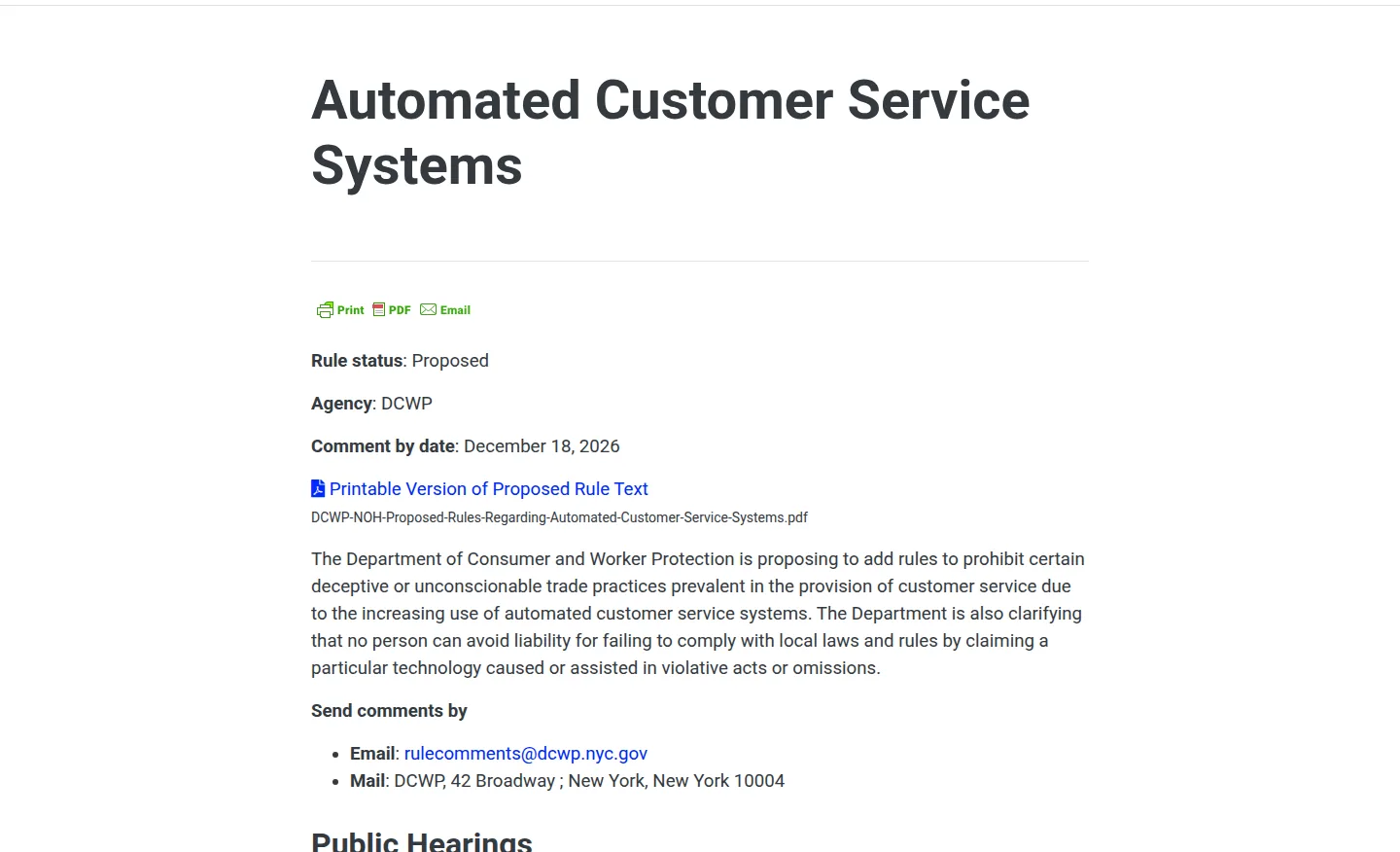
New York City’s Department of Consumer and Worker Protection published a proposed rule on October 20, 2026 that would make certain automated customer service setups a deceptive and unconscionable trade practice, with penalties starting at $525 per violation. A hearing is set for November 19, and the city’s portal takes comments to December 18, 2026. Nothing is enforceable yet.
What was actually released
The proposal adds three pieces to Title 6 of the Rules of the City of New York. A new section 5-02 closes the liability escape hatch: it is not a defense that the person relied on a technology that made the claims, omitted the statements or carried out the violating act.
A new Subchapter U defines the target. An automated customer service system is any technology where all or substantially all of the communication to the consumer is made by the technology rather than by a natural person. Customer service covers assistance in response to an inquiry about a product, service, account, refund, billing matter, complaint or dispute.
What the proposal requires of a merchant
- Say at the start that the consumer is talking to a machine, in the language of the conversation.
- Name the way out to a human, with the exact words or key press, and the estimated wait.
- Cover the hours when no human is available, with a committed response timeframe.
- Keep three years of records, machine-readable, and produce them on request.
Section 5-312 is the core. Disclosure comes first: clearly and conspicuously, at the start, in the language of the conversation. Failure to provide the promised service comes second, defined as repeatedly and unreasonably routing a consumer to menus that do not address the inquiry, or answering with unresponsive, irrelevant or wrong information. Access to a human comes third, and it carries the presumption: a merchant running an automated system without one of the two routes below is presumed to have violated the section.
| Route | What the merchant must put in front of the consumer |
|---|---|
| Single-step transfer | One clearly identified step, a button, voice command or menu choice, plus the exact instruction such as “Say or type agent” and the estimated wait |
| No human available, or an unreasonable queue | One alternative, with its hours or its response timeframe: transfer hours, phone, live chat, callback, contact form, text or email |
Section 6-91 sets the money, and each provision charged is a separate violation. A second or third violation counts only within two years of the earlier one.
| Violation | First | Second | Third and later |
|---|---|---|---|
| Service claimed on a channel that does not provide it | $525 | $1,050 | $3,500 |
| Automated system not disclosed | $525 | $1,050 | $3,500 |
| Promised service not provided | $525 | $1,050 | $3,500 |
| Records not kept or produced | $525 | $1,050 | $3,500 |
Section 5-313 is the part that changes a data pipeline: records kept at least three years, in machine-readable form, covering contracts, licenses and per-interaction logs showing duration, whether a transfer was offered, whether it was used, and where the consumer ended up. Then an annual aggregate with six counters, among them interactions with consumers who had already been in contact in the preceding 72 hours.
What the claim rests on
The structural change is not the fine. An automated system with no human option is presumptively a violation, so the question at a hearing stops being whether the bot eventually failed and becomes whether there was an exit.
The evidence is thinner than the drafting. The notice builds its case on consultancies and survey vendors rather than city data: resolution rates from Gartner running from 17% on billing disputes to 58% on returns, a Twilio finding that 40% of consumers say AI repeats itself or gets stuck, and a UJET survey where 72% called chatbot interactions a waste of time.
None of it describes New York City. The notice publishes no count of city merchants running automated service, no compliance cost, and no measurement of what disclosure would do. The surveys are self-reported, and they reach the rule through the vendors that commissioned them.
The use of automated customer service systems to provide customer service too often results in “doom loops,” maze-like processes, or in factually incorrect representations.
What the notice does not publish
- No effective date, and no cure period: the Mayor’s Office of Operations certification says a cure period is not practicable here.
- No definition of reasonable and timely, and no threshold for repeatedly and unreasonably. Both are left to enforcement.
- No small-business carve-out, and no cost estimate for the recordkeeping duty.
One detail decides whether a reader can still comment. The notice of hearing and the rule text put the deadline at November 19, 2026, the hearing date. The NYC Rules page says December 18. Only the portal has been updated.
On this page
What it changes for teams buying AI customer service
Procurement needs six new lines. Does it announce itself in every language the channel supports. Can it surface the exact phrase or key press that reaches a human, with the wait time. What happens when no human is on shift, and what response time is committed in writing. Can the vendor export the four per-interaction fields. Can it produce the six annual counters. Can all of it arrive machine-readable for three years.
Most dashboards answer none of them. They report deflection and containment, which measure whether the bot kept the consumer away from a human. The rule asks the opposite question, per interaction. Three years of interaction logs, machine-readable, produced on request is a schema decision.
Volume decides the arithmetic. Our reporting on Misumi India’s deployment across 40 million parts describes the profile the rule targets: a catalog too large for a menu tree. At that scale the 72-hour counter stops being a table row and shows whether the system defends the business or hides from it.
The fine is the cheap part. $525 for a first violation, $1,050 for a second, $3,500 for a third is a rounding error against three years of retained logs.
The Neural Minute take
This is the first American rule we have seen that puts a price on the AI-only support tier. The $525 is not the story, the presumption is. A merchant that replaced its queue with a bot had a defense: the bot is imperfect, but it is cheap. Section 5-312(c) removes it by default.
For anyone selling support automation into the US, human handoff moves from roadmap feature to procurement requirement, and “we do not log that” stops being an answer. For anyone buying, the clause to negotiate is not the price per conversation but the shape of the record and the retention window.
Two things to watch. Which deadline survives, because a merchant who trusts the notice and files on November 19 may still lose the chance to be heard. And whether a cure period appears in the final rule: the Operations certification says none is provided, so a first notice of violation arrives with a fine and no warning.
The notice points to disclosure statutes in California, Maine, New Jersey and Utah, and to a California provision already requiring food delivery platforms to connect a consumer to a person. If New York adopts this version, the recordkeeping duty becomes the heaviest piece of a scattered patchwork.
Sources
- The proposed rule page on NYC Rules, Department of Consumer and Worker Protection, published October 20, 2026: Automated Customer Service Systems
- The notice of public hearing and the full rule text, with the penalty schedule in section 6-91: DCWP notice of hearing