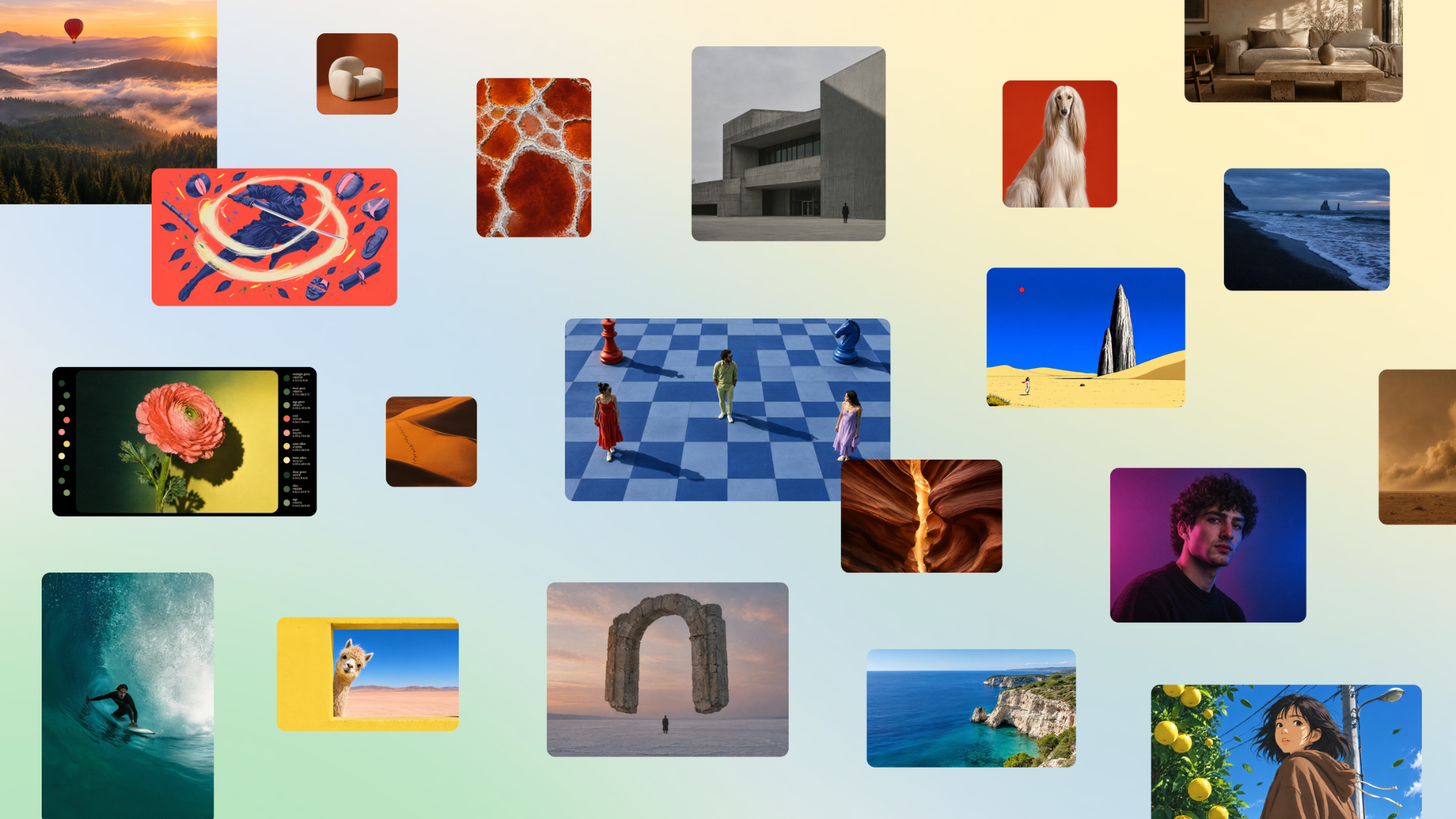
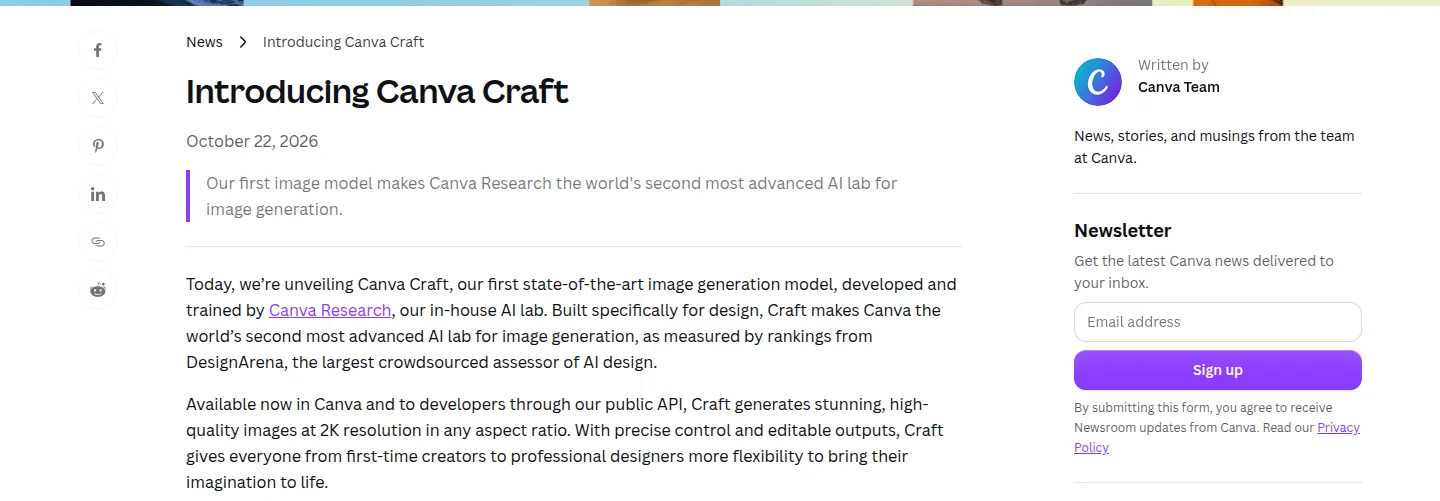
Canva published “Introducing Canva Craft” on October 22, 2026, its first image generation model, built and trained by Canva Research, the company’s in-house AI lab. Craft is live in Canva for all users globally and available to developers through a public API. Canva says the model debuted fourth on DesignArena, the ranking it cites as its reference, and that the result makes its own lab the second most advanced in the world for image generation.
What was actually released
Craft is a model, a place in the editor, and an API. The model is a two-stage system. A planning model reads the prompt and writes a detailed plan of the composition: which elements appear, their spatial relationships, relative scale, visual hierarchy, and any text that has to appear in the image. A rendering model then turns that plan into a picture at up to 2K resolution across more than 30 aspect ratios, or a ratio you type yourself. Prompts can be written in any language, and the model renders text in 55 languages.
The training mix is not the usual one. Canva says most image models are trained mainly on photographs and that Craft leans on design instead. Its training data includes millions of human-made templates from Canva’s own content library: posters, social posts, presentations, infographics, menus, layouts where type and hierarchy carry meaning. After pre-training, the model went through supervised fine-tuning and reinforcement learning with feedback from Canva’s professional designers.
The output is meant to stay editable. Because the model plans a composition as a set of layered elements, Canva uses JSON boundary boxing to push a generated image into Magic Layers, where the title, the product and the background become separate objects you can move. That separates Craft from a model that hands you a flat JPEG.
What you can use today
- Craft inside Canva, for all users globally, opened from Dream Lab in the bottom left panel.
- The public API, live now, so a team can run its own prompts and compare the result with any other model.
- The Canva MCP server, listed as coming soon, and two faster variants, Craft-fast and Craft-ultrafast, listed as upcoming. Neither has a date.
What the claim rests on
The announcement is built on a ranking rather than on a measurement. DesignArena, which Canva describes as the largest crowdsourced assessor of AI design, places models by human preference in head-to-head image comparisons. Canva reports five placements from it.
| What Canva claims | What the page actually gives |
|---|---|
| First in People and Portraits | rank 1 against 87 models |
| First in Landscapes and Nature | rank 1 against 85 models |
| Second in Abstract and Patterns | rank 2, field size not given |
| Fourth in Products | rank 4, field size not given |
| Fourth most advanced model at debut | rank 4 overall, field size not given |
| Second most advanced image lab in the world | Canva’s reading of the same ranking |
A first place out of 87 says that people preferred Craft’s images in the duels they were shown. It does not say the model delivers the composition you asked for, keeps your brand font on the poster, or holds up when you need forty variants of one layout. The number of votes behind those ranks is not published, and neither is the prompt set that produced the comparisons.
The internal evaluation has the same shape. Canva says its designers worked with dozens of researchers to judge more than 25,000 pairs of images against leading models, and that when automated scores and human judgments disagreed, the team sided with the designer. That is a defensible way to tune a model, not evidence a buyer can check: the models it was compared against are unnamed and the pairs are not published.
The speed claim is narrower than it reads. Canva says distillation cut the number of inference steps to a fraction of the original model, and that a custom inference engine made Craft an order of magnitude faster than its first internal version. That compares Canva’s own build with itself, and no figure in seconds is given.
Unlike conventional image generation models that generate pixels directly from a prompt, Craft uses a two-stage architecture that separates compositional planning from image rendering.
What the page does not publish
No price per image for the public API and no monthly generation limit for any Canva plan. No latency in seconds, no cost for Craft-fast, and no date for the MCP server. The 25,000-pair comparison names no baseline model, the arena placements come without vote totals, and nothing in the announcement has been replicated outside Canva.
On this page
What it changes for design and marketing teams
For a small team that ships social posts, ads and presentation visuals, the useful change is not the rank, it is the address of the model. Craft runs where the layout is assembled, and its output arrives as editable layers instead of a picture to be rebuilt. That removes a step that used to cost real time: generate elsewhere, download, import, mask, retype the headline. Text rendering in 55 languages matters for the same reason, since a localized campaign can be generated in the language of the market rather than retyped by hand.
A first place among 87 models is a vote count, not a delivery date.
The Neural Minute take
We priced Claid AI on October 3, 2026 for exactly this job, product and fashion imagery, and its numbers are the ones we can check. Essentials is $9 a month for 500 credits, and an AI Photoshoot generation costs 4 credits, which is 125 generated images. Pro is $35 for 2,000 credits, or 500 images. Both plans land at about 7 cents per generated image, with output capped at 2K on the cheaper tier and 4K on Pro.
Canva publishes nothing comparable for Craft. There is no credit cost, no per-image API rate and no monthly cap in the announcement, so the model cannot be placed on that ladder today. The public API is the only part of this release that produces a number a buyer can use. Run ten of your own prompts, count what you would keep, and divide your cost by that count. The result will be far from the leaderboard and much closer to your invoice.
Our reading of the training choice is that it buys speed and consistency, not originality. A model trained on millions of Canva templates learns the grammar of the well-made template: where a headline goes, how a hierarchy is spaced, how type sits against a photo. For a brand that wants every social asset to look like the last one, that is the feature. For a brand whose differentiator is a look that does not resemble a template, this is the median of what designers already made, and it will show.
What we would not do is move a catalog pipeline on the strength of a rank. The announcement names no date for the faster variants, sets no price, and leaves the MCP server unshipped, so the cheap test is the API this week and everything else waits for numbers.
Sources
- Canva, Introducing Canva Craft, October 22, 2026. Primary source: the model, the two-stage architecture, the 2K output, the 30 aspect ratios, the 55 languages, the DesignArena placements, the internal evaluation and the availability of the API.
- Canva, Introducing Canva Research, October 21, 2026. The lab behind the model, more than 160 AI research scientists and engineers within a 400-person AI unit.
- Neural Minute, Claid AI Review: Product Photos Priced in Credits, October 3, 2026. Our own price recording, the credit cost per operation and the per-image arithmetic used above.