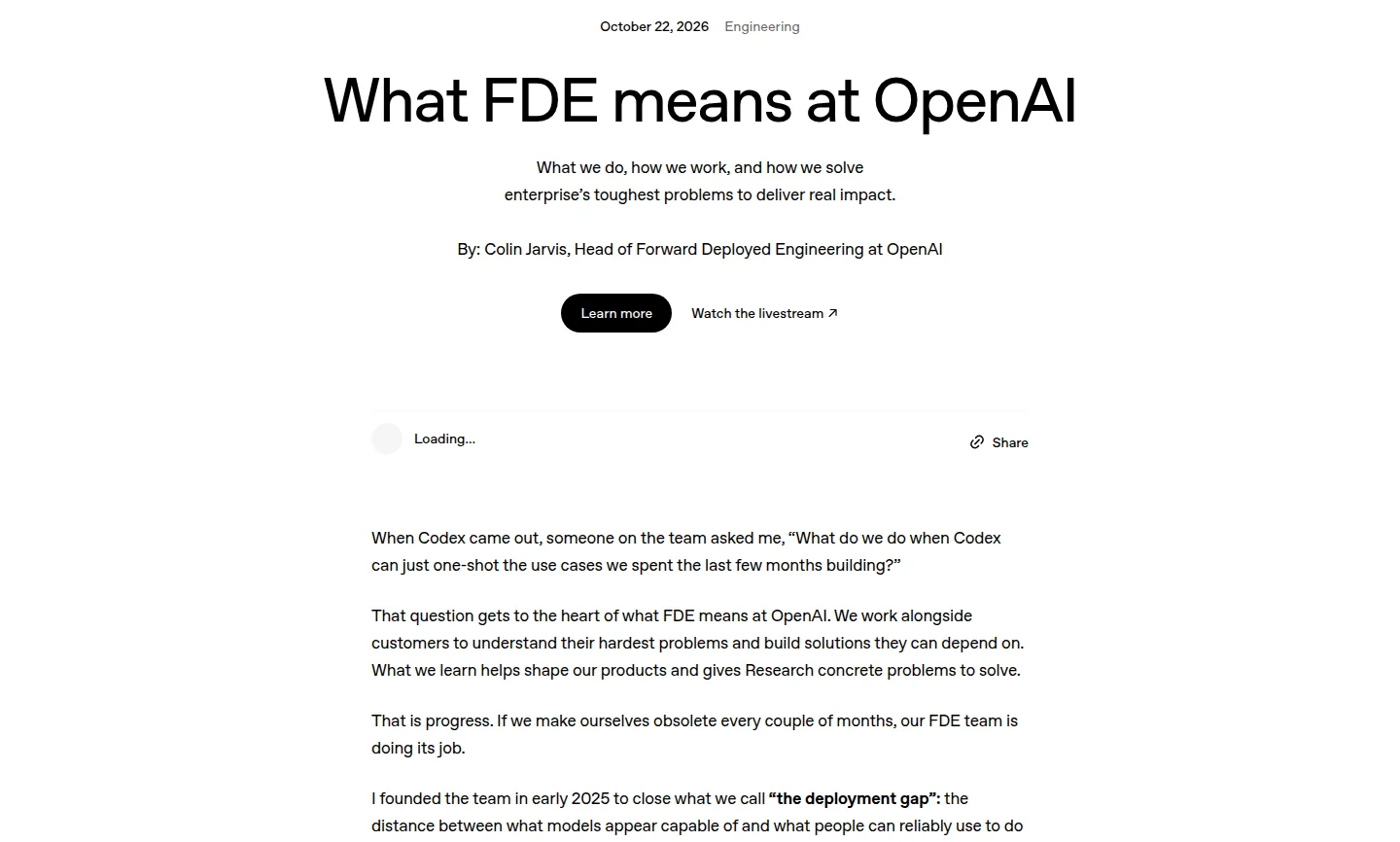
OpenAI put its deployment team on the record on October 22, 2026, in a post signed by Colin Jarvis, who heads forward deployed engineering there. It describes the work, the doctrine behind it, and the numbers OpenAI measured across a chipmaker, a tractor maker, a tax pilot in Crete and a phone company.
What was actually released
The team was founded in early 2025, and its target is what OpenAI calls the deployment gap: the distance between what models appear capable of and what people can reliably use to do their work. Sometimes a product is missing, and sometimes a model scores well on a benchmark and fails once real constraints arrive.
The first detailed customer is an unnamed semiconductor company. In mid-2025, around 15 forward deployed engineers worked there on more than 10 use cases, in an industry where verification is roughly 70 percent of a project’s effort. Some had never worked in semiconductors: they embedded with the verification team, studied chip design on their own time, and built evals to test whether the model could write useful tests and diagnose failures. OpenAI says all of the use cases reached production within three to six months.
What the post establishes
- The team has a named leader, a founding date in early 2025, and a written doctrine: start with the outcome, then make the success repeatable.
- OpenAI reports that a repeat rollout took one day after a first build that took two months.
- The unit also feeds Research with the tasks models still fail, and Presence, OpenAI’s enterprise voice and chat product, came out of this work.
The mechanical part carries more weight than the anecdotes. Once Codex became strong enough, one engineer rebuilt an application around it and moved the use cases onto a common harness. Custom applications became skills and plugins on Codex primitives, and the per-use-case terminal interfaces were retired. OpenAI puts the saving at roughly 90 percent of the custom code per project. In August 2026, the first deployment took two months and extending it to a second team took one day.
Two more customers appear with figures. Thrive Holdings and OpenAI built Tax AI for accounting firms in Crete, where a pilot processed 7,000 returns and raised throughput by about 50 percent; rental property returns, the hardest schedule, needed six weeks to reach 90 percent precision and recall. At a large telecom customer, voice is about 90 percent of service volume, and the model went from roughly 60 percent on the key evals in scoping to past 90 percent over six months.
What the claim rests on
Every figure is OpenAI reporting on its own work, with no outside audit and, in most cases, no named customer. That does not make the numbers wrong. It means each one has to be read for what it measures.
| What the post reports | The figure | What is not published |
|---|---|---|
| Directed test generation | ~48% time saved | Baseline, method, sample |
| Kernel optimization | 22% median gain | Baseline and sample size |
| Custom code after the Codex rebuild | ~90% removed | Which projects, over what period |
| Repeat rollout, August 2026 | 1 day against 2 months | Number of teams, upkeep load |
| Tax AI pilot, Crete | 7,000 returns, ~50% throughput | Error rate on filed returns |
| Telecom voice evals | 60% to 90%+ in six months | Which evals, which snapshots |
The 48 percent is the softest number in the piece. Time saved against what, measured by whom, on how many tests: none of it is stated. The 22 percent is called a median, which implies a distribution, and the distribution is not shown.
If we make ourselves obsolete every couple of months, our FDE team is doing its job.
That sentence is the thesis, and it cuts both ways. If the team is meant to disappear from a workflow, what it leaves behind is the product, not the engagement. The post never says what a customer keeps when the relationship ends.
What the page does not say
No price, no contract length, no headcount beyond the one figure from mid-2025, and no list of customers under engagement today. It does not say how the 48 percent and the 22 percent were measured, or whether the tax pilot’s returns were filed as generated or reviewed line by line. The claim that one Presence customer handles more than half its calls with AI comes with no window and no name.
On this page
What it changes for a team buying AI tools
The useful shift is in what you ask before signing. A demo answers whether the model can do the task; this post is about a different question: what the second team costs after the first one ships. The distance between two months and one day decides whether a workflow spreads through a company or stays with the group that paid for it.
That reframes three things a buyer controls. The first is the eval set: the telecom case worked because both sides agreed on what production grade meant before the work started. If you cannot write that test, you cannot tell a rollout from a demo. The second is ownership of the glue: OpenAI deleted most of it and moved the rest onto its primitives, which lowers your maintenance bill and raises your dependence on one product line. The third is the schedule: a capability moving from 60 to 90 percent in six months is a date, and buying early means buying an integration project.
The same pattern runs through every enterprise AI deal we have covered this month, from Block cutting patch time to 18 minutes to AT&T planning natural language intake for hundreds of lawyers. The vendor’s engineers are in the room in each one.
The Neural Minute take
Our reading of those case studies is that the gain comes from the harness, not the model. Block, Sophos, Oracle and Sullivan and Cromwell all describe a build that sat next to someone who knew the workflow. This post describes that harness in OpenAI’s own words, and the honest version is unglamorous: embed, write the evals with the customer, keep what works, delete the rest.
The line worth stealing is the one about making the team obsolete. Applied to a purchase, it gives a test no benchmark can pass. Ask what the second deployment costs, not what the demo scored. If the answer is another six-month project, you are buying consulting with a model attached. If the answer is a day, the workflow is real.
Our reservation is the one we apply to every vendor figure. The most transferable number here, one day against two months, comes from one unnamed semiconductor customer in one August. Treat it as a direction, not a rate, until a second customer reports the same ratio.
What we would do with this: pick the workflow where you know the definition of done, write the eval before the first call, and ask two questions in writing. Who owns the skills and connectors when the engagement ends, and what the second team cost in the last three deployments.
Sources
- What FDE means at OpenAI, OpenAI, October 22, 2026, signed by Colin Jarvis, Head of Forward Deployed Engineering. Every figure here is read there.
- Named in the post: John Deere, Thrive Holdings with Tax AI for accounting firms in Crete, and OpenAI Presence. The semiconductor company and the telecom customer are not named.
- Our earlier coverage of the same pattern: Block uses OpenAI Daybreak to cut patch time to 18 minutes and OpenAI Daybreak cuts Sophos response time to 89 seconds.