
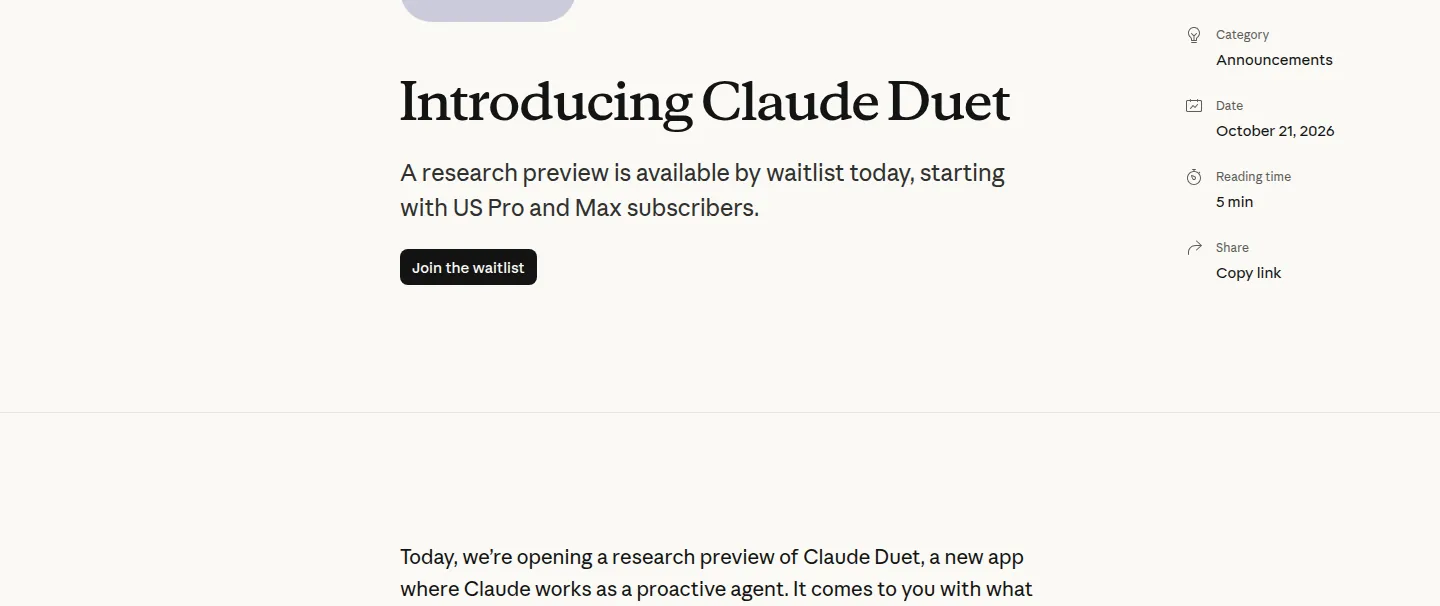
Anthropic opened a waitlist for Claude Duet on October 21, 2026, a research preview of a separate app in which Claude works as a proactive agent. It is limited to Claude Pro and Max subscribers in the US, ships on iOS, Android and claude.ai, and is built around Opus 5.5. It carries no separate price: it is included in the two plans and spends their limits.
What was actually released
Duet is not a new model and not a new chat window. It is an agent with a virtual machine and its own browser, which keeps working after you close the laptop, plus one thread you can type or speak into. Memory, skills and connected apps carry over from the Claude account.
Three behaviors separate it from the chat app. It sends a morning brief on the most important items across connected apps. It then checks those apps every few hours and messages you only when something needs attention, which Anthropic says is deliberate, since checking nonstop would use plan limits faster. And it stops before acting: before it sends a message, makes a payment, signs a document or deletes anything, it shows what it is about to do and waits.
The connectors show the scope. Anthropic puts the Claude Marketplace at over 6,000 connectors and plugins and names a sample: Gmail and Slack for missed messages, QuickBooks and Stripe for unpaid invoices, Gusto for payroll, Docusign for agreements, HubSpot and LinkedIn. Purchases run through Link, Stripe’s wallet, on a virtual card; saved 1Password logins are listed as coming soon.
Credentials follow the design already used for Claude Managed Agents, so the agent does not see passwords or tokens. Approvals pass through the auto mode classifier, and a new classifier reads each message: credit card numbers and government identification are rejected outright, and health or finance details go out only on explicit instruction. Red teams and an external firm tested it.
| Item | What the pages say |
|---|---|
| Plans | Pro and Max only, US only, by waitlist |
| Apps | iOS, Android, claude.ai |
| Model | Claude Opus 5.5 |
| Usage | Shared with the plan; background checks count |
| Connectors | Over 6,000 in the Claude Marketplace |
| Approval gates | Messages, payments, signatures, deletions |
| Off-limits | Securities trading, transfers between accounts |
| Team and Enterprise | Not included in this preview |
What the claim rests on
The evidence is testimony, not measurement. The announcement quotes three people inside Anthropic, including the leads on the app, and three small business owners with early access: a broker whose property showing was flagged as booked on the wrong day, a restaurant owner with about 110 employees, and a brand strategist. Each is a plausible use, none is a number, and none comes with a before and after.
The figures that look most like a result come from a demo. The product page walks through a coffee chain raising money, with 41 opening checklist items, 33 on track, $528K of weekly revenue and a $640 permit fee paid from the thread. That is a scripted walkthrough of an interface, not a report from a business that ran it.
What is not published
No date for general availability beyond the waitlist, no price for the app, and no country list after the US. Nothing on how much of a plan’s usage a day of background checks consumes, no rate for how often Duet escalates something that could have waited, and none for how often it stays quiet on something that could not.
The honest sentence is the one about metering. Anthropic says the app checks connected accounts every few hours rather than continuously, because continuous checking would burn plan limits faster, and that larger tasks such as a financial model or a deck need more model turns and more background work.
On this page
What it changes for someone paying for Claude
The app costs nothing extra and the usage does. Duet is included in Pro and Max and shares their limits with the rest of Claude, so every morning brief comes out of the same pool as your chats and your Claude Code sessions. On the price page read on October 22, 2026, Pro is $17 per month on annual billing, with $200 up front, or $20 billed monthly, and Max starts at $100.
| Plan | Price per month | Claude Duet |
|---|---|---|
| Pro | $17 annual, or $20 monthly | Included, waitlist |
| Max | From $100 | Included, waitlist |
| Team | $20 per seat, annual billing | Not yet |
| Enterprise | $20 per seat, billed annually | Not yet |
Plan prices as published by Anthropic on claude.com/pricing, read on October 22, 2026. Nothing on that page says how many checks a plan absorbs.
So the first week should be a measured test, not a habit: note the usage before, run the app for a fixed number of days with the settings you want, then read the delta, because that delta is the price of the feature. Anthropic charges $4 per million input tokens and $20 per million output for Opus 5.5 on the API, what background work would cost if you built it yourself.
Outside the US there is nothing to decide yet, and inside a company on Team the question is governance rather than price: the app reads mail and can pay invoices, and those are the plans Anthropic leaves out of the preview.
The comparison will be with assistants that only answer. Our October 20 piece on Google’s Personal Intelligence covers an assistant that reads your own accounts to answer a question you ask, on a car screen, each answer triggered by you. Duet inverts the direction: it decides when to speak, acts on the apps, and can pay within limits you approve. The gap is not intelligence, it is who starts the exchange.
The Neural Minute take
Before it sends a message, makes a payment, signs a document, or deletes anything, it shows you exactly what it is about to do and waits for your approval.
That sentence is the most important thing in the release, and it is not what the launch leads with. The launch leads with judgment, the part nobody can measure yet. The approval architecture is published, testable, and decides whether an agent that reads your inbox is a colleague or a liability.
Our reading is that Anthropic shipped the guardrails before the numbers, and the numbers are what to ask for. A proactive agent is a metered service sold as a feature: the more useful it is, the more it checks, and the more of your plan it consumes. Ask for the checks per day, the tokens per check, and the escape rate on urgency. Without those three figures, the demo of the coffee chain is the only yardstick on offer, and it is fiction.
Two things we would not do yet. We would not build a workflow that depends on Duet, because it is a research preview limited to the US and Anthropic says it may miss what arrives between check-ins. And the waitlist is not a rollout schedule: no date, no price, no second country.
The part worth watching is not whether the brief is good. It is whether the cost of a brief is published, and whether the approval classifier can be inspected by the people who rely on it. An agent that pays your suppliers is judged on its refusals, not its summaries.
Sources
- Introducing Claude Duet, claude.com, published October 21, 2026: https://claude.com/resources/articles/claude-duet
- Claude Duet product page, including the FAQ on plans and usage, read on October 22, 2026: https://claude.com/product/claude-duet
- Plan prices and Opus 5.5 API rates, read on the Anthropic price page on October 22, 2026: https://claude.com/pricing
- No third-party account, newsletter or aggregator was used for any fact in this article