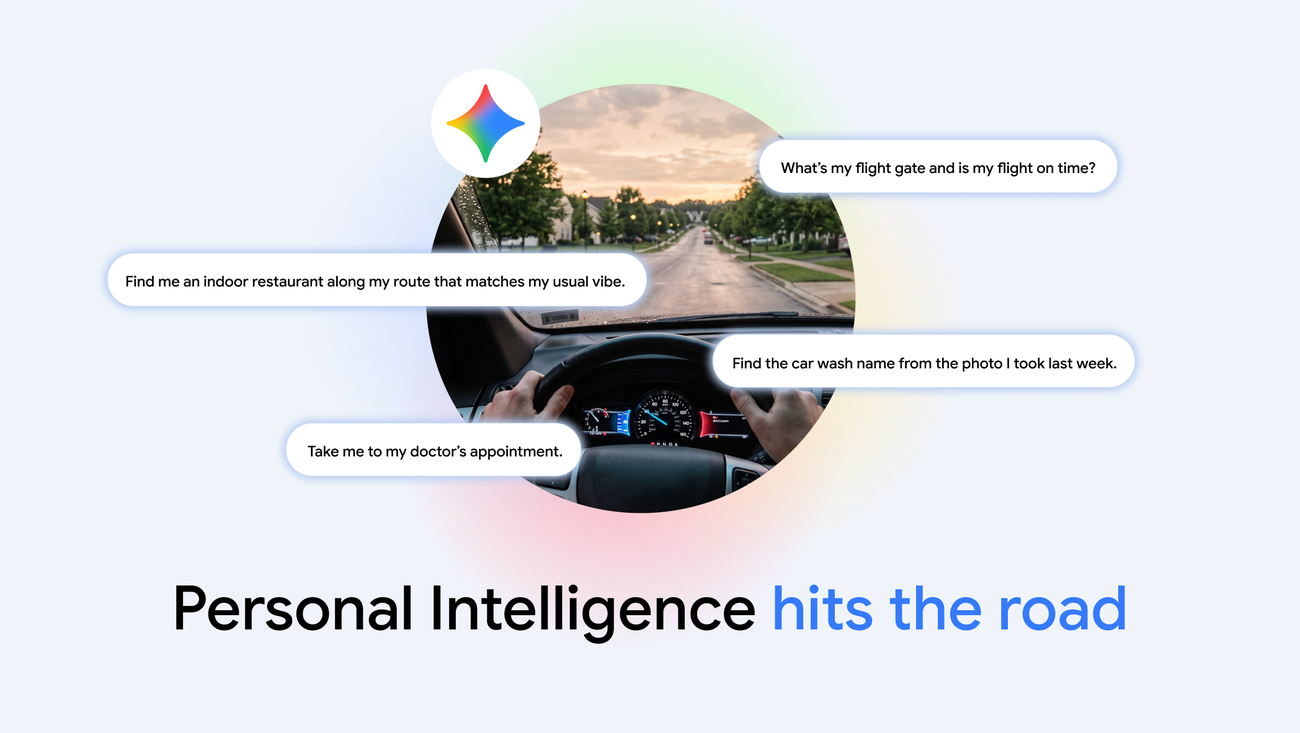
Google started rolling out Personal Intelligence in cars on October 20, 2026, beginning with Android Auto and promising cars with Google built-in in the coming months. Gemini already answered questions by voice in the car. What changes is that it can now read the account behind the question, pulling from a driver’s own Gmail, calendar, photos, saved places, YouTube history and Search after an explicit opt-in.
What was actually released
Personal Intelligence is not a new model. It is a permission layer with a retrieval step in front of the assistant: once connected, Gemini can lift a specific detail out of one of your Google apps, or combine several of them into one answer, without you naming the source. Google describes two strengths on the page, retrieving a detail from an email, a photo or a place saved in Maps, and reasoning across complex sources, and gives five worked examples rather than any specification.
The examples all assume a question that would otherwise take three steps on a phone: a flight gate and a delay in the same breath, an indoor restaurant along the route that fits a vegetarian diet, a doctor’s appointment by name rather than by street address. Two are memory tasks, a car wash photographed last week, a coffee shop mentioned yesterday. The pattern is consistent: the driver says the thing, Gemini does the digging.
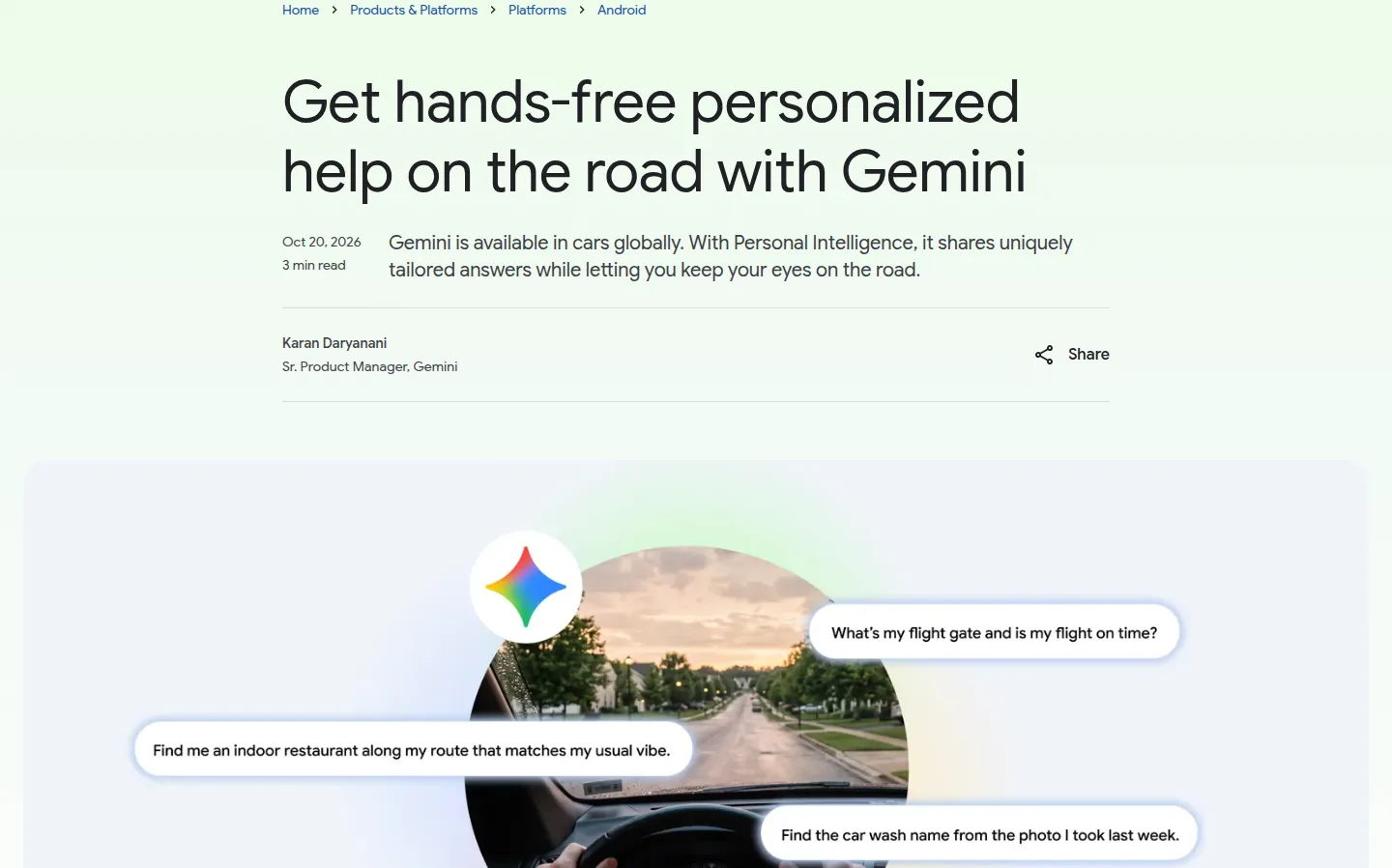
The perimeter matters more than the demos, because it decides who can use the feature at all. Every condition below is stated on the same page.
| Question | What Google states |
|---|---|
| Where it runs now | Android Auto, starting October 20, 2026 |
| Where it runs next | Cars with Google built-in, in the coming months |
| Apps it can read | Workspace (Gmail, Calendar), Photos, Maps, YouTube, Search |
| Account types allowed | Personal Google accounts, age 18 and over |
| Account types excluded | Workspace business, enterprise and education |
| Markets excluded | EEA, Switzerland, United Kingdom, Nigeria |
| If you leave it off | Navigation, music, calls and questions still work, untailored |
What to remember
- The personal layer is opt-in and reversible in Gemini settings, not a default.
- If you already switched it on in the Gemini app, it comes with you into the car.
- On cars with Google built-in, personal answers are only shared while you are in the car with your phone connected.
The fallback is spelled out plainly: without Personal Intelligence, the car still navigates, plays music, takes calls and answers questions, but the answers are not tailored.
What the claim rests on
The claim rests entirely on illustration. The page carries no accuracy figure, no response time, no count of supported vehicles, no list of regions, no date for the built-in rollout beyond “in the coming months”, and no statement of which model answers in the car. Five sample prompts are the whole evidence base for “uniquely tailored answers”, and sample prompts show what a feature is meant to do, not how often it does it.
An assistant is even more helpful when it knows the world and knows you.
The privacy section is a policy statement plus one testable rule. The policy is that apps stay unconnected until you turn the feature on and can be switched off at any time. The testable rule is the built-in case: personal responses are shared only when you are in the car with your phone connected, which tells you where the request is assembled. Neither statement is a data retention promise, and the page makes none.
What is not published
Nothing on the page says how long an in-car request is kept, whether a personalized answer is written into Gemini Apps activity the way a typed prompt would be, or whether the car keeps a transcript of the conversation. There is no price, no plan name and no usage cap attached to the feature, and no list of the car models or countries where the built-in rollout will land first.
The account carve-out appears twice, in the body and in the fine print at the foot of the page. Personal Intelligence is limited to eligible personal accounts aged 18 and over, and excludes Workspace business, enterprise and education, along with the European Economic Area, Switzerland, the United Kingdom and Nigeria.
On this page
What it changes for anyone paying for an AI assistant
The first consequence runs against the way most people buy AI. A paid Workspace seat is excluded from this feature, while a free personal account is eligible. A subscription can be the thing that costs you the feature, and nothing in the announcement suggests a paid tier that restores it. Anyone running a small business on a Workspace domain should assume the car stays untailored until Google says otherwise.
The second is geographic and travels with the account, not the trip. The European Economic Area, Switzerland, the United Kingdom and Nigeria are named as exclusions, so a reader in those markets cannot evaluate the feature by using it. Reading the announcement is the only option available, and the announcement is five prompts long.
The third is the surface itself. A car accepts one turn, spoken, with no screen to correct a bad retrieval on. When the answer is a flight time pulled from the wrong email, the cost of a miss is not a follow-up prompt, it is a wrong turn. Google publishes no accuracy figure for this surface, which is where a retrieval error is hardest to catch.
The fourth is continuity. If Personal Intelligence is already on in the Gemini app, the car inherits it; if it is not, the driver has to find the setting. That makes the setting, not the car, the place where the feature is actually switched on.
The Neural Minute take
Our own rule when a launch ships no number is to treat the number as pending, not as absent. Google has been concrete about money lately: Gemini 4 Argon came with a rate of $2 per million tokens, and the Gemini agent on Google Cloud came with hard spend caps. This release has no token count, no cap and no price, because it is not selling capacity. It is selling a habit: the moment a driver stops reaching for the phone is the moment the assistant becomes the default, and defaults are worth more later than any single feature is worth now.
For a reader deciding what to pay for, the practical reading is narrower than the announcement. Do not buy a plan for this. Nothing published says a paid Gemini plan adds anything in the car, and the only personalization switch that matters is already free to flip in settings. What the release does change is the cost of not having context: once a passenger has seen the car answer from a calendar, the untailored assistant starts to feel broken.
Two things we will watch. The first is the fine print of the built-in rollout, because the gap between Android Auto today and built-in cars in the coming months is where account rules usually change. The second is retention, since an assistant that reads mail and photos in a moving vehicle creates a record in a place with no screen to review it afterwards. Until Google publishes either, the honest description of Personal Intelligence in a car is a feature that works as demonstrated, on the examples its own authors chose.
Sources
- Personal Intelligence brings Gemini to cars globally, Google, published October 20, 2026. The page this article reads for the release, the five examples, the account rules, the market exclusions and the retention silence.