Exa released Exa 3.0 on October 19, 2026, and calls it the largest improvement to its search quality so far. The launch keeps the same API surface, splits search into two price tiers, and makes a token-saving feature generally available. Everything ships on the existing index, so an existing integration can move without code changes.
What was actually released
Three retrieval changes, according to the announcement. First, a larger embedding model, trained with more compute and data than any previous Exa model. Second, Dynamic Highlights, now generally available at no extra charge: instead of clipping highlights from each page, the model selects tokens across all results, giving more room to the best pages and cutting repeated information. Third, a much wider index, which now carries 1.27 billion ecommerce listings with prices and availability, 211 million local businesses with hours and ratings, plus flights, events, transit, podcasts, and real-time news, sports, weather, and market data.
The pricing change is the part a buyer will notice. Exa Lite is a new search type at $4 per 1,000 requests, running on the same index as Exa Auto, which stays at $7 per 1,000 requests. The company says Auto spends more compute across candidate generation, highlights, and ranking.
What is on the invoice
- Exa Lite at $4 per 1,000 requests, or $0.004 per call.
- Exa Auto at $7 per 1,000 requests, or $0.007 per call.
- Dynamic Highlights and the expanded index included in both, at no extra charge.
| Endpoint | Published price | Cost per call, our arithmetic |
|---|---|---|
| Lite search | $4 per 1,000 | $0.004 |
| Auto search | $7 per 1,000 | $0.007 |
| Deep search | $12 per 1,000 | $0.012 |
| Answer | $5 per 1,000 | $0.005 |
| Contents | $1 per 1,000 pages | $0.001 |
| Monitors | $15 per 1,000 | $0.015 |
Prices read on the Exa pricing page on October 20, 2026, in dollars, for up to 10 results per request. The third column is our division, not a figure Exa publishes.
What the claim rests on
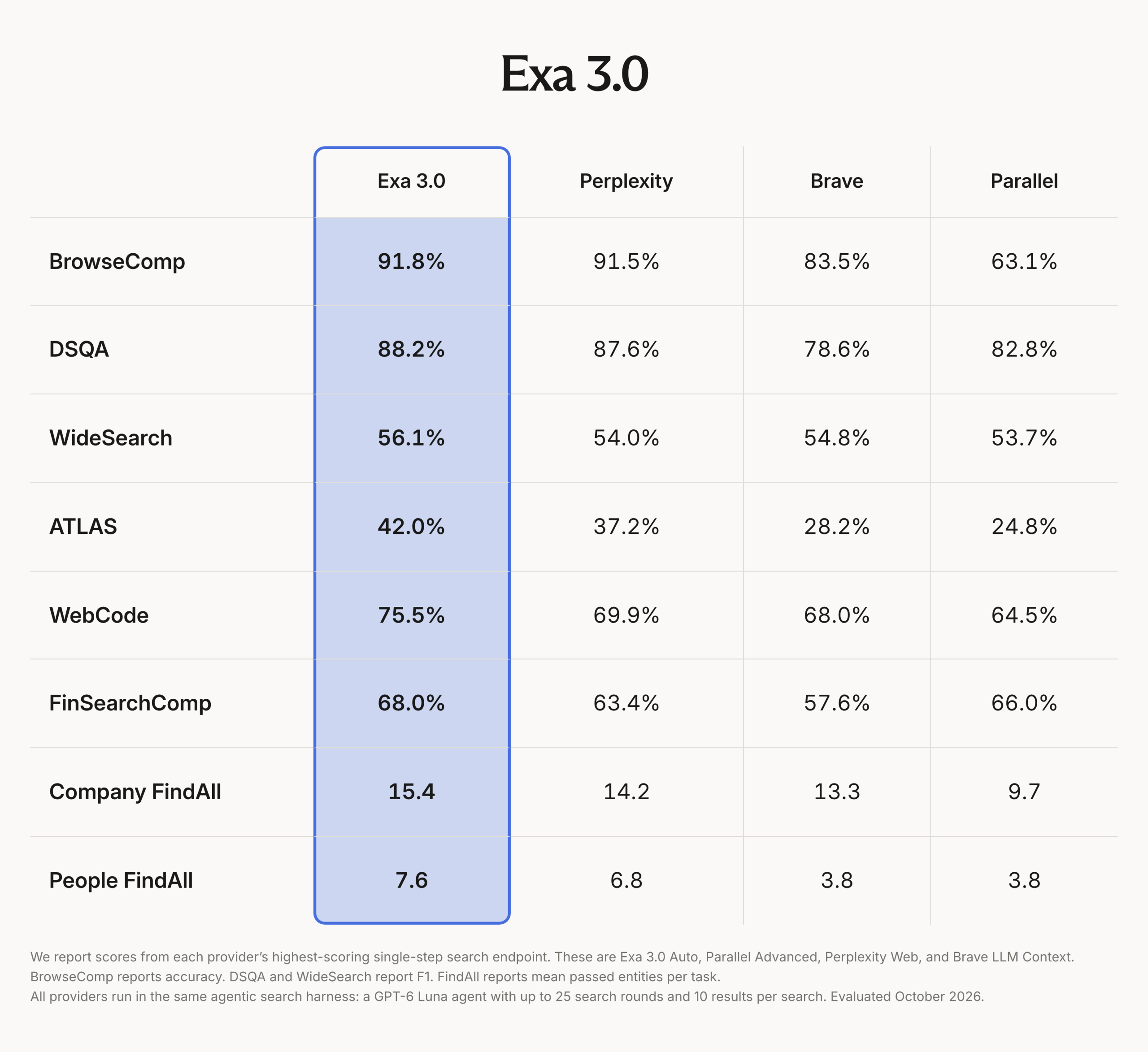
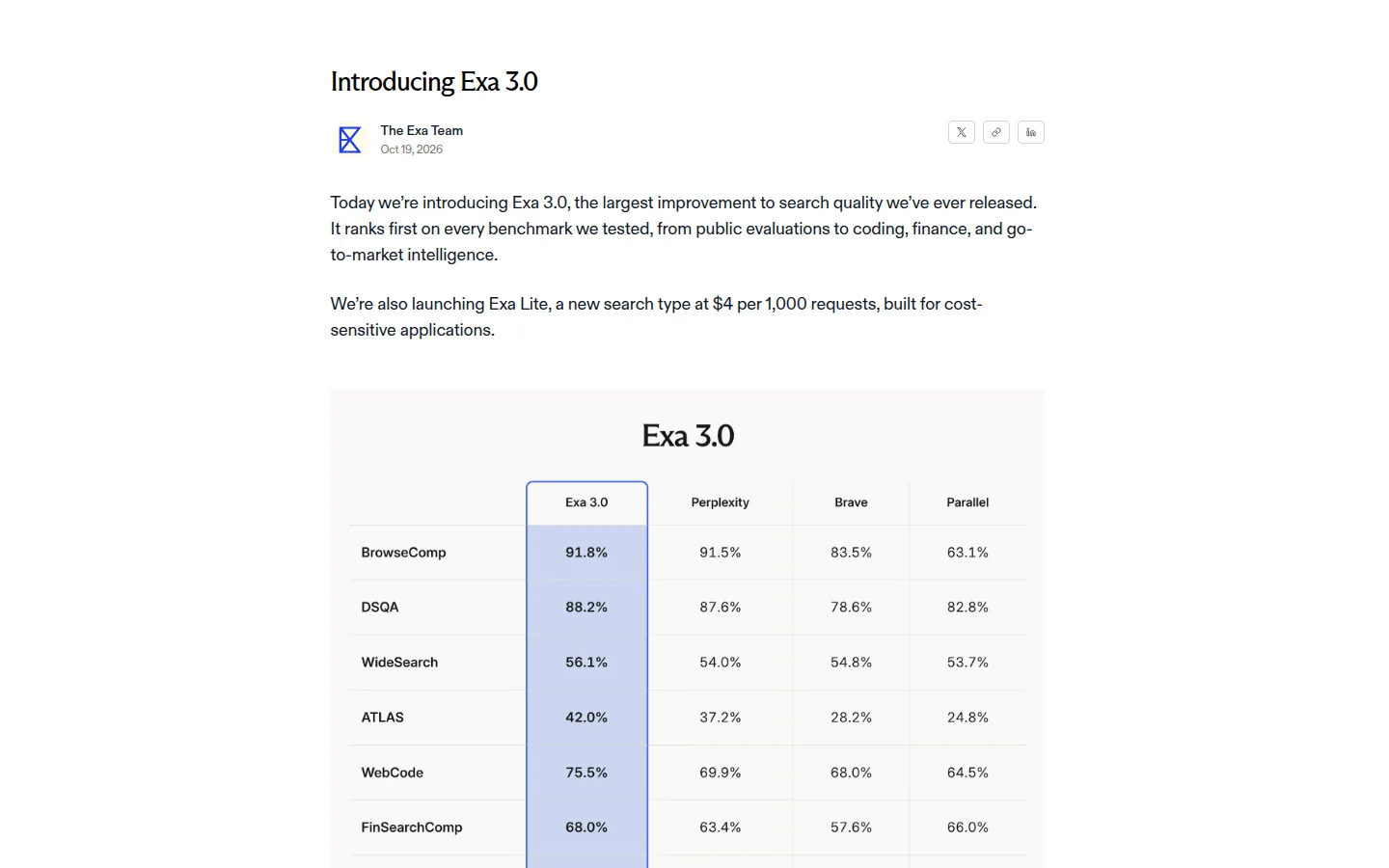
The headline is a ranking claim: Exa 3.0 leads on evaluations spanning coding, finance, deep research, and company intelligence. What the page publishes for it is a chart at the top of the post, plus this sentence:
It ranks first on every benchmark we tested, from public evaluations to coding, finance, and go-to-market intelligence.
That is a strong claim and a thin proof. The post lists no per-benchmark scores, no task counts, no model used to grade, and no link to a results table on this launch. The benchmark set is described by category, not named. The method Exa has used before is its own harness with an LLM judge, run on its own side, which is defensible for a launch post but is not an independent evaluation, and nobody outside the company has reproduced the 3.0 numbers yet.
The token claim is more precise and still not checkable from the page. Dynamic Highlights uses 95% fewer tokens than full page text, which means about 5% of the original text volume survives. The page does not break that down by site type, does not publish a quality delta per domain, and does not say what is lost when a page is compressed to a twentieth of its text. A product page, a forum thread, and a legal filing compress very differently.
What is not published
- A scores table for the benchmarks in the chart, with task names and counts.
- Any independent replication of the ranking claim.
- The quality gap between Lite and Auto, beyond “more compute”.
- Per-tier latency, and rate limits for Lite at scale.
Latency is the one operational number the pricing page does carry: 450 ms to 1 second, described as configurable. The launch post publishes no measurement per search type, so the question a production team will ask, what Lite adds in milliseconds, has no published answer.
On this page
What it changes for teams that put search inside an agent
Search calls were never the expensive part. At $0.004 a call, a million Lite searches cost $4,000, against $7,000 on Auto: a $3,000 gap at a million calls a month. That is real money at volume, and it is small next to what the returned text costs once it reaches a model.
That is where the 95% matters. Take a page averaging 2,000 tokens of text and a model billed at $3 per million input tokens. Feed full page text into a million searches and you buy 2 billion tokens, or $6,000. With highlights at 5% of the text, the same million searches buy 100 million tokens, or $300. Those are our assumptions, not Exa’s figures, and your pages and your model rate decide the gap. But the direction is stable: on a retrieval pipeline, context is the line item, and the search call is a rounding error next to it.
The index expansion changes a different decision. Prices and availability on 1.27 billion ecommerce listings, hours and ratings on 211 million local businesses, and real-time sports, weather, and market data turn a general web index into something closer to a catalog and places API. A shopping assistant or a store locator that used to need a second vendor can now be built on one key, which is a procurement shortcut more than a quality argument.
Before switching anything, test the cheap tier on your own queries. The only question that matters is whether Lite answers your queries as well as Auto does. A 43% price cut that costs you one wrong answer in twenty is not a price cut.
The Neural Minute take
The number to remember from this launch is not $4. It is 95%.
Exa is selling a smaller bill at somebody else’s meter. Every token a search API returns is a token you pay for again at your model provider, and most retrieval pipelines in production are spending more on the context they feed forward than on the search that fetched it. A vendor that competes on text volume is competing on your total cost, not just its own line. That is a better pitch than a benchmark chart, and it is measurable in an afternoon on your own logs.
Which is why the ranking claim deserves the skepticism and the token claim deserves a test. One is a picture of a comparison run by the company that wins it. The other is an engineering claim you can check in an afternoon: pull the last 200 queries your agent actually ran, search both tiers, and compare the answers your model produces with each. That costs cents and settles more than the chart does.
For a small team, the order is straightforward. Add Dynamic Highlights if you are still sending full page text, then measure your own answers before moving a single query to Lite. The savings are easy to model. The quality claim is easy to verify, so verify it.
Sources
- Exa, Introducing Exa 3.0, published October 19, 2026, read on October 20, 2026. Prices, index figures, and the ranking claim come from this page.
- Exa, pricing page, read on October 20, 2026. Lite, Auto, Deep search, Contents, Monitors, and Answer rates, and the 450 ms to 1 second latency range.
- Exa, State-of-the-art web search API, the earlier evaluation post that documents the company’s own harness and LLM-judge method.
- The cost per call, the monthly comparison at one million searches, and the token arithmetic are our calculations from those published rates, with the assumptions stated in the text.