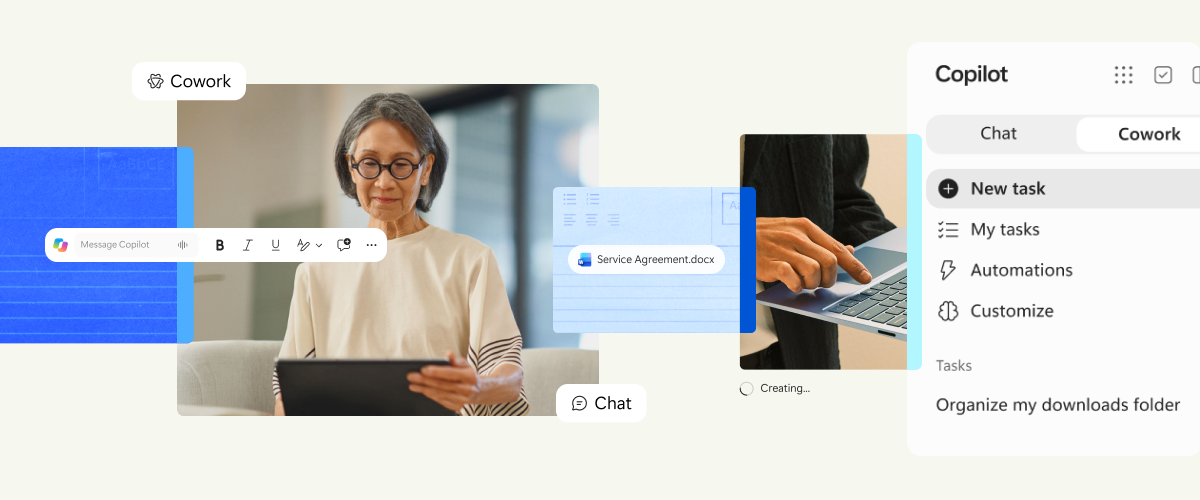
Microsoft made more than 20 purpose-built legal skills generally available in Copilot on October 15, 2026, and started rolling out partner-built legal plugins through its plugin registry. The set builds on Legal Agent, the Word feature Microsoft shipped in April, and it is available worldwide to Copilot customers today.
What was actually released
This is not a new model and not a separate product. It is a bundle of skills inside Copilot, split across two surfaces: Copilot in Word, where the work happens in the document, and Copilot Cowork, where a legal professional can hand over a task that spans several files and steps.
In Word, the skills are built for agreement work. When Copilot proposes a redline, Word applies it as a native tracked change and keeps the document’s formatting, so the edit lands in the review flow a lawyer already uses. When drafting, the skill can pull from approved precedents stored in SharePoint and build structured placeholders with Word content controls, which stay editable across the document.
In Cowork, the scope widens: tracking obligations and deadlines across a contract portfolio, comparing key terms across agreements, and building case chronologies from meeting records and files. Work IQ, the layer that connects Copilot to the organization’s own knowledge, sits underneath both surfaces.
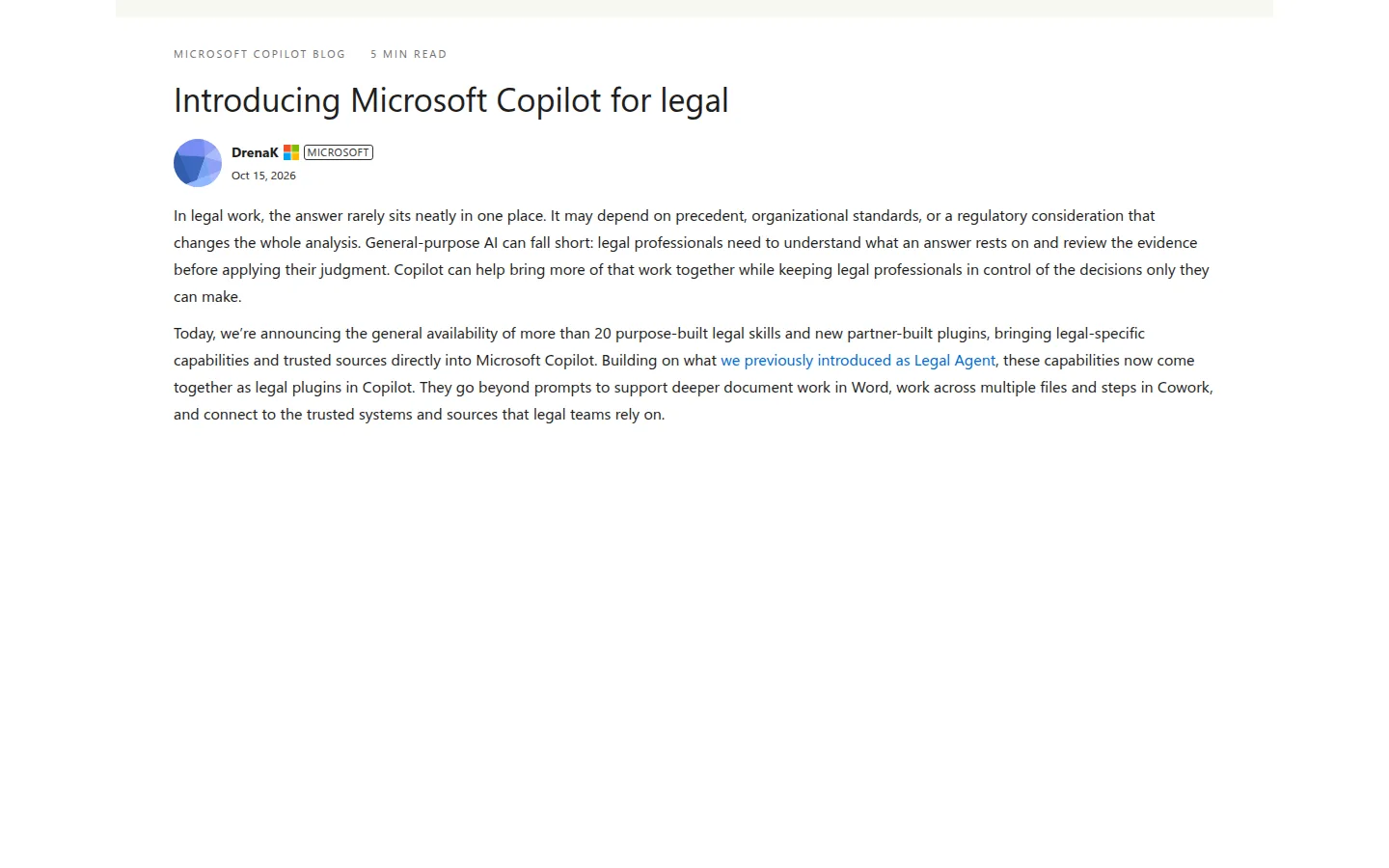
Microsoft groups the capabilities under five kinds of work: drafting from approved precedents, reviewing and negotiating against playbooks, extracting obligations and deadlines, turning research into structured guidance, and moving matters forward with chronologies and minutes. A separate Word experience for navigating defined terms and their definitions is due in preview later this month.
The partner side is what turns Copilot into a hub rather than a closed tool. Legal research plugins are rolling out from Bloomberg Law, Trellis, Descrybe, Legal Data Hunter, Courtroom5 and Lawstronaut. Document, matter and transaction management plugins come from iManage, NetDocuments, Box, Litera, HighQ, LegalZoom and Solve Intelligence. Signature and agreement tools include Docusign, Juro, Adobe Acrobat Sign, LawVu, SignatureAPI, Dropbox Sign and PandaDoc. Harvey, Legora and DeepJudge cover specialized legal AI, and Everlaw and Relativity cover e-discovery.
What the claim rests on
Microsoft publishes three sets of numbers, and they measure different things.
The first is adoption inside its early program. Since the April Frontier release, more than 1,800 users have generated nearly 100,000 edits and kept roughly seven in ten suggestions.
The second is an internal quality score on the edits themselves: more than 90% fluency, more than 95% conciseness, more than 85% relevance. Microsoft calls these internal evaluations. It does not publish the sample, the rubric, the document count or who did the scoring.
The third is a time claim, and it arrives as a quotation rather than a measurement. Aneesh Mehta, senior corporate counsel at Microsoft, says that a review that might take an hour can often take several minutes.
| Figure | Value | What it actually measures |
|---|---|---|
| Users in the early program | more than 1,800 | seats touched since April, inside Microsoft and invited teams |
| Edits generated | nearly 100,000 | proposals produced, kept or not |
| Suggestions kept | roughly 7 in 10 | the share a lawyer accepted |
| Fluency | more than 90% | Microsoft’s internal score on the edit |
| Conciseness | more than 95% | Microsoft’s internal score on the edit |
| Relevance | more than 85% | Microsoft’s internal score on the edit |
What the numbers do support
Roughly seven in ten suggestions were kept, which means three in ten were not. That rejection rate is the useful figure: it is the review load a team inherits, and it was measured on Microsoft’s own documents by Microsoft’s own staff.
What is not published
No price and no plan are named for the legal skills. The post says they are generally available to Copilot customers worldwide, without saying which subscription qualifies, whether the legal set costs extra per seat, or what a firm without Microsoft 365 Copilot would pay to reach it. There is also no latency figure for multi-file Cowork runs, no stated limit on how many documents one task can span, and no independent evaluation of the legal output.
On this page
What it changes for a legal team already paying for Copilot
If the firm already runs Microsoft 365 Copilot, the decision is small: the skills appear where the documents already live, and the output arrives as a reviewable artifact rather than a chat answer. That is the difference between a tool a lawyer tries once and a tool that survives a matter, because a tracked change is something a supervising partner can check.
The second change is the input. These skills are only as good as the playbook and the approved precedents they are pointed at. A firm that has never written down its fallback positions will get edits that look confident and concede nothing. Loading its standards into the system is now part of adopting the tool, and it is not the part vendors demo.
The third is the partner layer. If iManage, NetDocuments, Bloomberg Law or Docusign are reachable from inside Copilot, the reason to open a separate legal product shrinks for research and document handling, and holds for the deep analytical work those products were built around. The registry, not the model, is where that boundary gets drawn. For the opposite architecture, a firm building its own reviewer on a general coding agent, see our note on Sullivan and Cromwell’s Agreement Analyzer.
These are more than prompts layered on a general-purpose model.
That is Microsoft’s own framing, and it is the claim a pilot should test: whether the skill applies the firm’s playbook, or produces a plausible paragraph that a lawyer then has to rewrite.
The Neural Minute take
The announcement is stronger as a distribution play than as a capability claim, and the numbers say so. Microsoft does not argue that its legal skills beat Harvey or Legora. It argues that 1,800 users produced 100,000 edits without leaving Word, and it lists Harvey and Legora as plugins rather than as rivals. When a competitor is also a plugin in your registry, the fight is over the surface where the work starts.
Three questions we would put to Microsoft or to a reseller before a pilot, because the page answers none of them:
- Which subscription includes the legal skills, and what does a seat cost on top of the Copilot license the firm already pays for?
- What happens to the suggestions lawyers reject: is the rejection recorded, and can a firm see which clause types fail most often?
- Do the partner plugins bill through Microsoft or directly, and who holds the data when a document moves from Copilot into a partner system?
The takeaway for a buyer is narrower than the headline. The tracked change is the feature worth testing, because it keeps the review where the liability sits. The rest, including the count of 20 skills, is packaging.
Sources
- Introducing Microsoft Copilot for legal, Microsoft Copilot Blog, published October 15, 2026.
- The figures in the table were read on that page on October 19, 2026: more than 1,800 users, nearly 100,000 edits, roughly seven in ten suggestions kept, and the three internal evaluation scores.
- The partner plugin list, the five work categories and the defined-terms preview date come from the same page. No third-party report was used for any figure here.