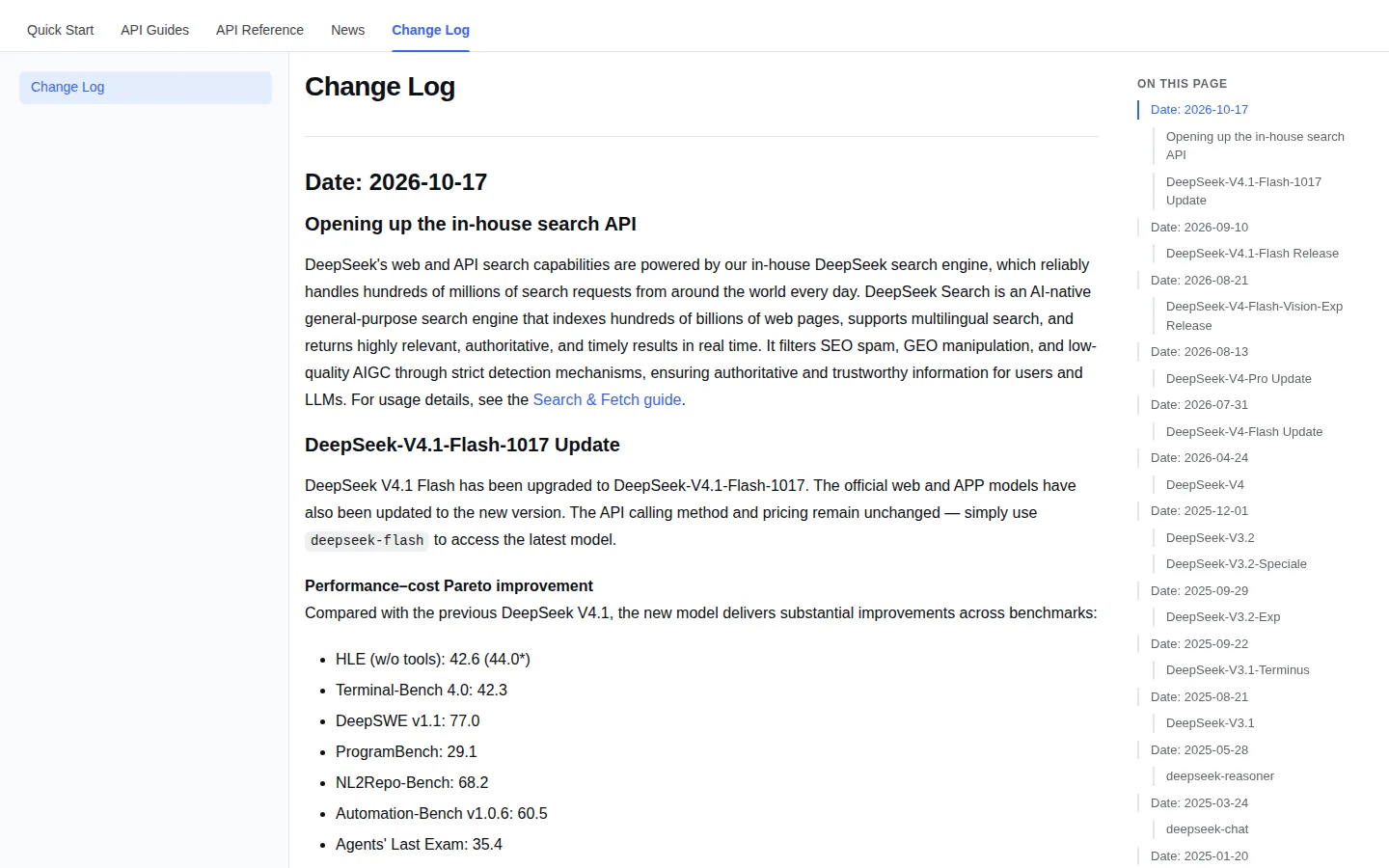
DeepSeek dated two changes in its API changelog on October 17, 2026. One opened the search engine it built for its own chat product as a paid API; the other replaced DeepSeek V4.1 Flash with a retrained build, DeepSeek-V4.1-Flash-1017, on the same model name and the same price. Both land on one key and one invoice.
What was actually released
The retrieval layer is two endpoints on the existing API host. Search takes a query and returns structured results; fetch takes one address and returns the page as Markdown. Search accepts a query of 1 to 128 characters, a count between 1 and 50 with a default of 10, an optional original question, an IP address for localization, and a flag that returns page content next to each result. Operators such as site restrictions pass through intact.
The limits are per account, not per key: 100 requests per second on search and 25 on fetch, with separate quotas and HTTP 429 above them. Fetch also has a per-domain cap.
What lands on the bill
Search and fetch bill at $0.75 per 1,000 successful requests, not per token and not per returned result. A request counts only when it returns HTTP 200 with a result, so failures and timeouts are free. Server-side tool calls through DeepSeek Harness, Claude Code and Codex cost nothing until November 1, 2026 at 00:00 Beijing time.
On the model side the change is an upgrade in place. Flash was retrained, the web and app models moved to the same build, and the changelog states that the calling method and the pricing are unchanged: the name is still deepseek-flash. The two names DeepSeek retired in September, deepseek-v4-flash and deepseek-v4-flash-vision-exp, are still accepted, but their requests now land on the 1017 build at the Flash rate.
Published capabilities: a 1 million token context, a 384,000 token maximum output, vision input, tool calls, the Responses API format, an Anthropic-compatible endpoint, and a concurrency ceiling of 2,500 requests for Flash against 500 for V4 Pro. DeepSeek adds that it tuned the model for Harness, Tencent CodeBuddy and WorkBuddy, and asks users to run Harness 0.2.1-rc.1 or later.
The claims compare the 1017 build with the September 10 one:
| Benchmark | September 10 build | 1017 build | Change |
|---|---|---|---|
| HLE, no tools | 36.8 | 42.6 | +5.8 |
| HLE, pure text subset | 39.1 | 44.0 | +4.9 |
| Terminal-Bench 4.0 | 31.2 | 42.3 | +11.1 |
| DeepSWE v1.1 | 74.2 | 77.0 | +2.8 |
| ProgramBench | 20.3 | 29.1 | +8.8 |
| Automation-Bench | 54.8 | 60.5 | +5.7 |
| Agents’ Last Exam | 31.8 | 35.4 | +3.6 |
| Chartography, with tools | 78.9 | 83.0 | +4.1 |
| ZeroBench-main, with tools, Pass@5 | 49.0 | 51.0 | +2.0 |
Scores as published in the two changelog entries, read on October 19, 2026. Automation-Bench is not like for like: the new entry labels it version 1.0.6, September’s carried no version. Apex Bench v1.1 at 72.1 is left out because September reported MathArena Apex at 65.6, a different test.
What the claim rests on
Every number in that table is DeepSeek’s own run. The changelog names the framework for two of them, Claude Code for Terminal-Bench 4.0 and Mini-SWE-V2 for DeepSWE, and notes that the HLE figure covers only the pure-text subset. It publishes no system card, no number of runs per task, no variance, and no ablation separating new weights from a harness tuned at the same time. The direction is consistent, with the largest jumps on the coding benches where the harness matters most, but nothing here has been reproduced outside DeepSeek.
The cost claim is weaker. The entry says:
While improving performance, we also reduced the model’s task runtime and output length, enabling users to complete tasks at lower cost and higher speed.
That is the sentence that would justify the word cheaper, and it arrives without a single figure: no median latency, no tokens per task, no cost per completed task. A reader can check that the rate card did not move, not that the same job now costs less to finish.
What DeepSeek does not publish
No latency, no output token counts, no cost per task, so the speed claim rests on the same vendor table as the quality claim. No statement of how much of the gain is the retrained model and how much is harness tuning. And no way back: the retired names route to the new weights.
The price, unchanged, reads like this per million tokens:
| Rate | Off-peak | Peak |
|---|---|---|
| Input, cache hit | $0.003 | $0.006 |
| Input, cache miss | $0.15 | $0.30 |
| Output | $0.60 | $1.20 |
Rates for Flash, read on the pricing page on October 19, 2026 and confirmed unchanged by the changelog. V4 Pro sits at $1.98 and $3.96 on output for the same peak and off-peak split.
On this page
What it changes for teams running agents
Retrieval gets easy to buy. At $0.75 per 1,000 successful calls a search costs $0.00075 and the failures are free, which makes broad research cheap to run. But the search fee is the smallest part of it. A search returning content pulls full pages into the prompt, and those bill as input tokens at the model rate: three 4,000-token pages come to 12,000 input tokens, about $0.0018 off-peak on a cache miss, more than twice the call that fetched them and close to five times at peak. The billable unit is the request, but the costly unit is the text it drags in.
Version control gets harder. The string deepseek-flash now points at a build that replaced the one it pointed at in September, and the older names route to the same weights. An application that pinned a model name did not pin a model, and anyone with an eval suite has to re-run it, because the changelog is the only signal that the weights moved.
A third consequence is quiet until November. Teams calling DeepSeek through Harness, Claude Code or Codex already hit search and fetch server-side at no charge. From November 1 that traffic bills per request, so a line item appears without a change in usage and without a note on the invoice.
The Neural Minute take
DeepSeek is no longer selling only a model. It sells the retrieval layer under it, on the same key, at a unit price low enough that retrieval looks free next to the tokens it produces. That reframes the cheapest way to run an agent: fetch once, keep the result cached, let the hit rate do the work. The price list makes the point better than any benchmark, with input at $0.003 cached against $0.15 uncached off-peak, a factor of fifty on the same tokens. An agent that searches the web on every turn pays twice, once for the calls and once for the context it rebuilds.
On the model itself, the honest reading is a solid incremental build sold as a headline. Terminal-Bench 4.0 going from 31.2 to 42.3 matters for coding agents, and is also the figure most dependent on a harness DeepSeek tuned. With a bill this month we would run our own tasks on deepseek-flash before moving a workload, and use the free window on server-side search calls to measure now rather than after November 1. If the numbers hold, the price makes Flash the cheapest credible agent tier. If they do not, the entry that announced the upgrade removed the way back.
Sources
- DeepSeek, Change Log, entries dated October 17, 2026 and September 10, 2026. Read on October 19, 2026.
- DeepSeek, Search and Fetch guide, endpoints, request fields, rate limits and billing. Read on October 19, 2026.
- DeepSeek, Models and pricing, rates and concurrency limits for Flash and V4 Pro. Read on October 19, 2026.
More model news sits in the news hub.