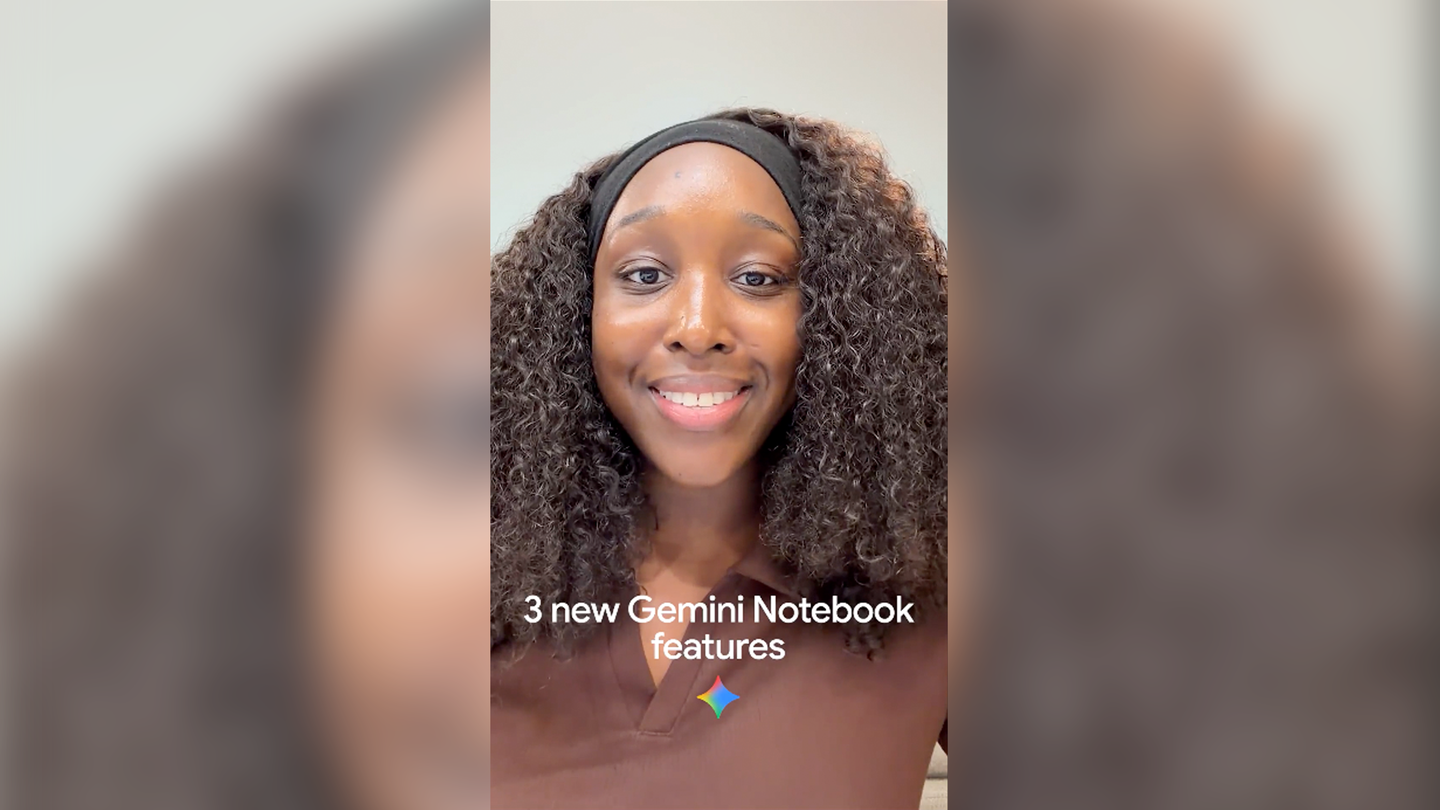
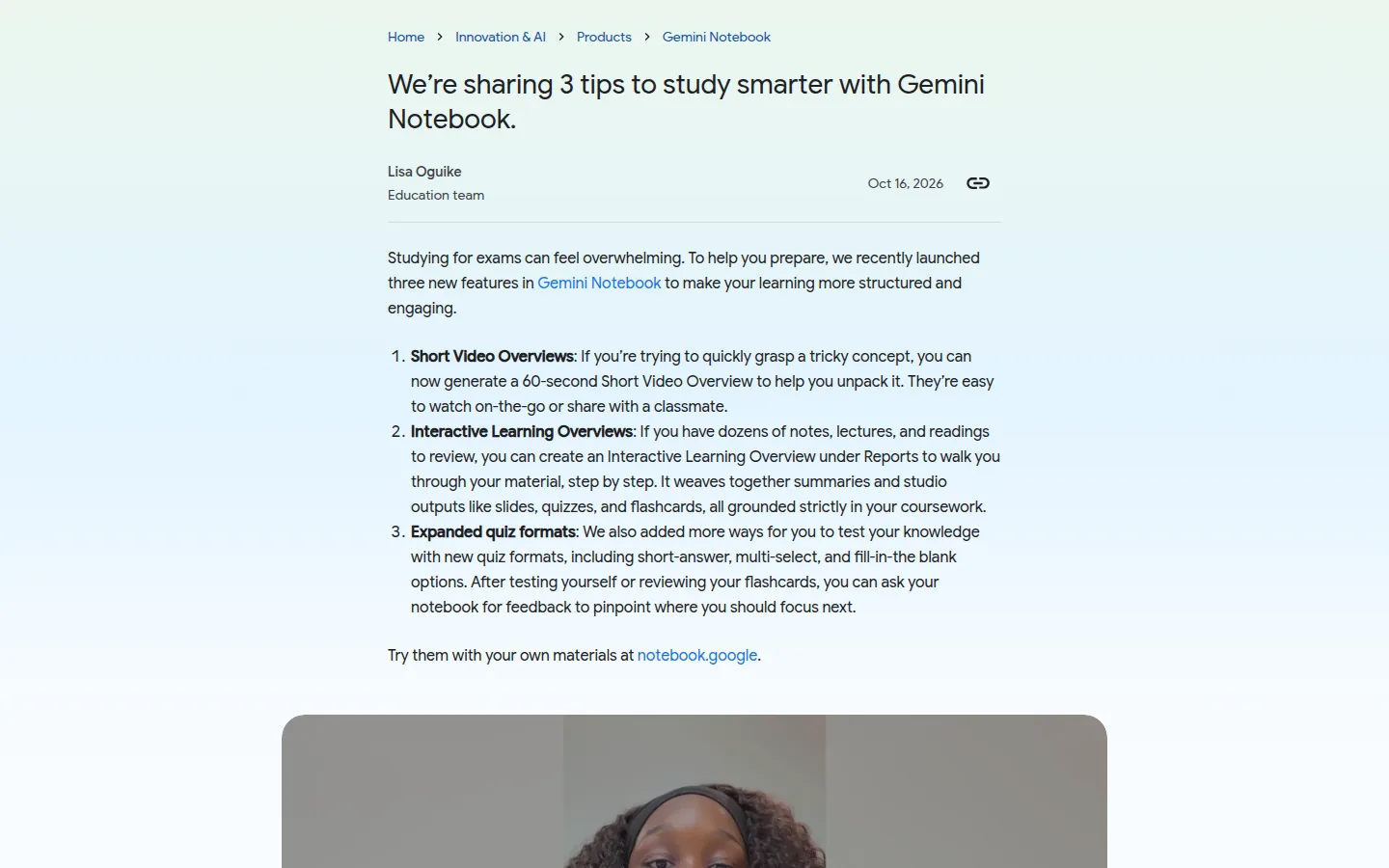
Google published three new study features for Gemini Notebook on October 16, 2026, in a post signed by Lisa Oguike of the company’s education team. The additions are a 60-second short video overview of a single concept, an interactive learning overview that walks a student through their own material step by step, and three more quiz formats. The post is written as study advice for exam season, and no price, rollout schedule or availability list is attached to the three.
The product is the study assistant Google built on the research tool it used to call NotebookLM, a rename our coverage of the Egypt student offer recorded on October 12, 2026, when the free Google AI Plus plan listed it as Gemini Notebook.
What was actually released
All three sit inside the notebook a student already keeps, and each one is a shorter route to the same material.
| Feature | What the post says it does |
|---|---|
| Short Video Overviews | Turns a concept a student finds tricky into a 60-second video, made to watch away from a desk or share with a classmate |
| Interactive Learning Overviews | Created under Reports, walks through notes, lectures and readings step by step, weaving summaries together with slides, quizzes and flashcards |
| Expanded quiz formats | Adds short-answer, multi-select and fill-in-the-blank questions, with a feedback pass that points to what to review next |
The post closes by pointing readers at notebook.google to try the three on their own material. It does not say which plans carry them, so the only way to know whether an account has the video overview is to open a notebook.
What a student can act on today
- A 60-second video overview generated from the material already sitting in a notebook.
- An interactive learning overview under Reports, which the post says stays inside the coursework a student uploaded.
- Three added quiz formats, and a feedback pass after a test or a flashcard review.
- All three are reached from notebook.google, on a student’s own material.
What the claim rests on
The post is a set of tips, and that shapes what it can prove. Google writes that it launched the three recently, and the page carries a single date: October 16, 2026, the day it was published. There is no product announcement for the features, no version number, and no note saying when they reached the accounts that already have them.
The strongest sentence in the post is also the one a reader cannot check from outside.
It weaves together summaries and studio outputs like slides, quizzes, and flashcards, all grounded strictly in your coursework.
Grounded is doing the work in that sentence. How the overview checks the material, what it does when two sources in the same notebook disagree, and whether an output names the source it leans on are all left unsaid. There is no figure of any kind: no adoption number, no time-saved claim, no evaluation of the quiz formats. The 60 seconds describes the length of a video, not what a student keeps after watching it.
What Google does not publish
Which plans carry the three features, between the free tier, Google AI Plus and Google AI Pro; the countries and languages where they are live; whether video overviews are capped per day per account; whether an overview or a quiz can leave the notebook in a portable format; and any date for the three reaching accounts that do not have them yet. On publication day, the only evidence a reader holds is a tips post.
One more gap sits in the filing. The web address ends in three-tips, the headline calls them tips, and the document title calls them three new study features.
On this page
What it changes for students choosing a study tool
The three formats are the paid core of the study apps we review. A summary that reads a lecture back at you, a quiz that marks it, and flashcards to carry into an exam are what a student subscribes for, and Google now ships all three inside a product it gives away with a notebook.
That moves the cost question. Our Mindgrasp review found no public price page when we checked the vendor on October 3, 2026, and a free session instead of a rate card. A study app that will not publish a price is hard to weigh against a free tier that adds the same formats. The comparison tilts further for anyone whose notes already live in Gemini Notebook, because the material is the input the three features run on. Our education and study tools list is where we keep the alternatives.
Three questions decide whether any of this changes a student’s spend: whether the free tier keeps the video overviews once the exam season passes, whether the material can leave the notebook, and whether the feedback pass on a quiz beats a set of handwritten notes. The post answers none of them, and for an account holder they are one login away.
The Neural Minute take
Our read is that these three features matter less for what they add than for where they are added. A one-minute video, a walkthrough that stitches the sources together and a quiz that tells you where to look next are exactly the bundle a student pays a study app for. Google placed the bundle in the tier it gives away, on the same product the free student plan we described on October 12 already carried.
The phrase we would not repeat is grounded. A grounding claim is the one thing a blog post cannot settle about a study tool. We have no notebook of our own to test the overview against, and Google published no measurement, so the sentence reads as a promise rather than a result. That is not a knock on the feature; it is the state of the evidence on publication day, and we would rather write it down than upgrade the claim.
What we would do with a real course: build one interactive overview and one quiz from the readings, then read the feedback and check whether it points at a section that can be named. If it does, the study-app subscription is the line item under review. If it does not, the 60-second video is a preview and nothing more. A video that fits in a minute is a format, not proof that anyone learns faster.
One number would change our read, and it is the one we would ask Google for: a published cap on video overviews per account per day. That single figure decides whether a student is looking at part of a plan or at a demo of one.
Sources
- Google, “We’re sharing 3 tips to study smarter with Gemini Notebook.”, published October 16, 2026 and signed by Lisa Oguike of the education team, for the three features and the sentence quoted above: https://blog.google/innovation-and-ai/products/gemini-notebook/three-tips-study-gemini-notebook/
- The same page, read on October 16, 2026: the 60-second length of the short video overview, the placement of the interactive learning overview under Reports, the three added quiz formats, and the pointer to notebook.google
- Our own reading, October 16, 2026: the post carries no plan list, no country or language list, no daily cap on video overviews and no date for wider availability
- Our Mindgrasp review and the price check run on October 3, 2026, for the missing public rate: https://www.neuralminute.com/reviews/mindgrasp/