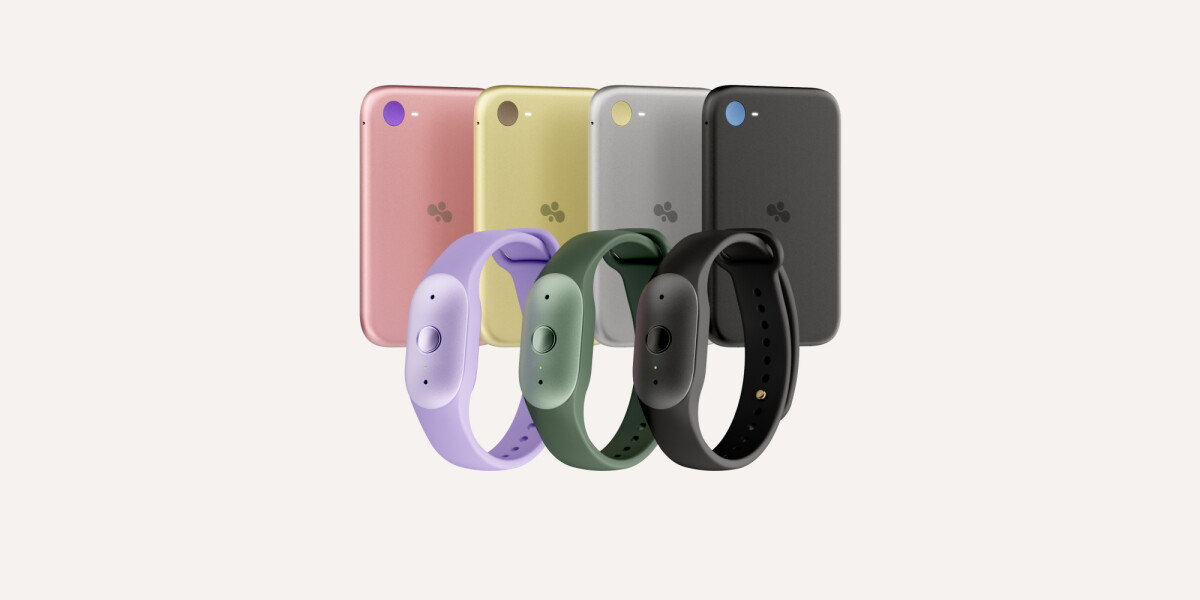
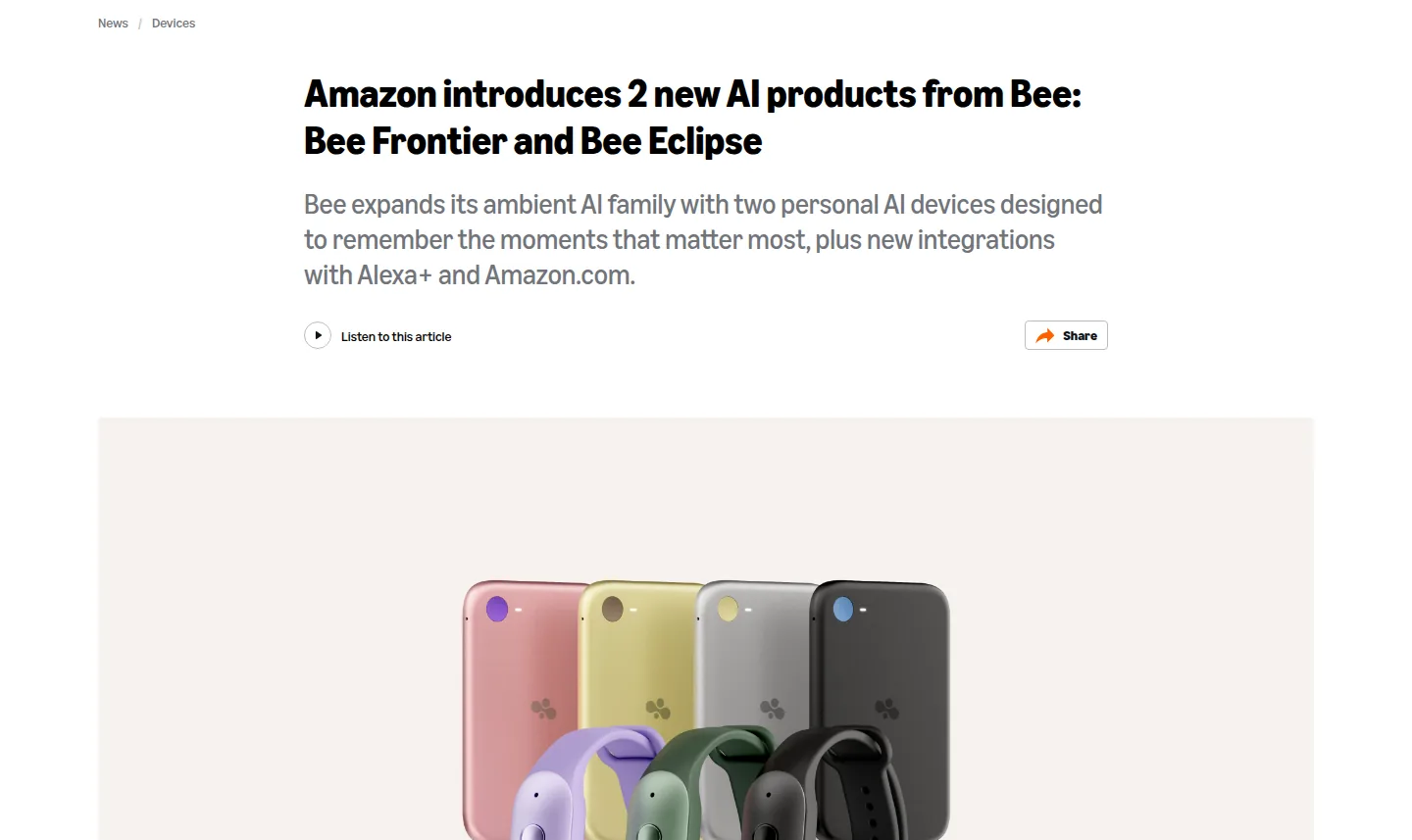
Amazon announced two new Bee devices on October 15, 2026: Bee Frontier, a wearable that goes on a wristband or clips to clothing, at $74.99, and Bee Eclipse, a magnetic attachment the size of a credit card that sticks to the back of a phone, starting at $99.99. Both turn conversations into summaries, to-dos and reminders, and both connect to Alexa+ and to Amazon.com. Frontier is on sale now and Eclipse is not, and every figure in this article comes from that one page.
What was actually released
Two pieces of hardware and one recurring charge. Bee Frontier is the second generation of the wearable line that started with Bee Pioneer, and the page lists the specifications itself: IP67 water resistance, up to seven days of battery life, USB-C charging, dual microphones with noise filtering, and three colors. Bee Eclipse trades the wristband for a magnetic plate on the back of a phone, with more than 21 days of battery life on a single charge.
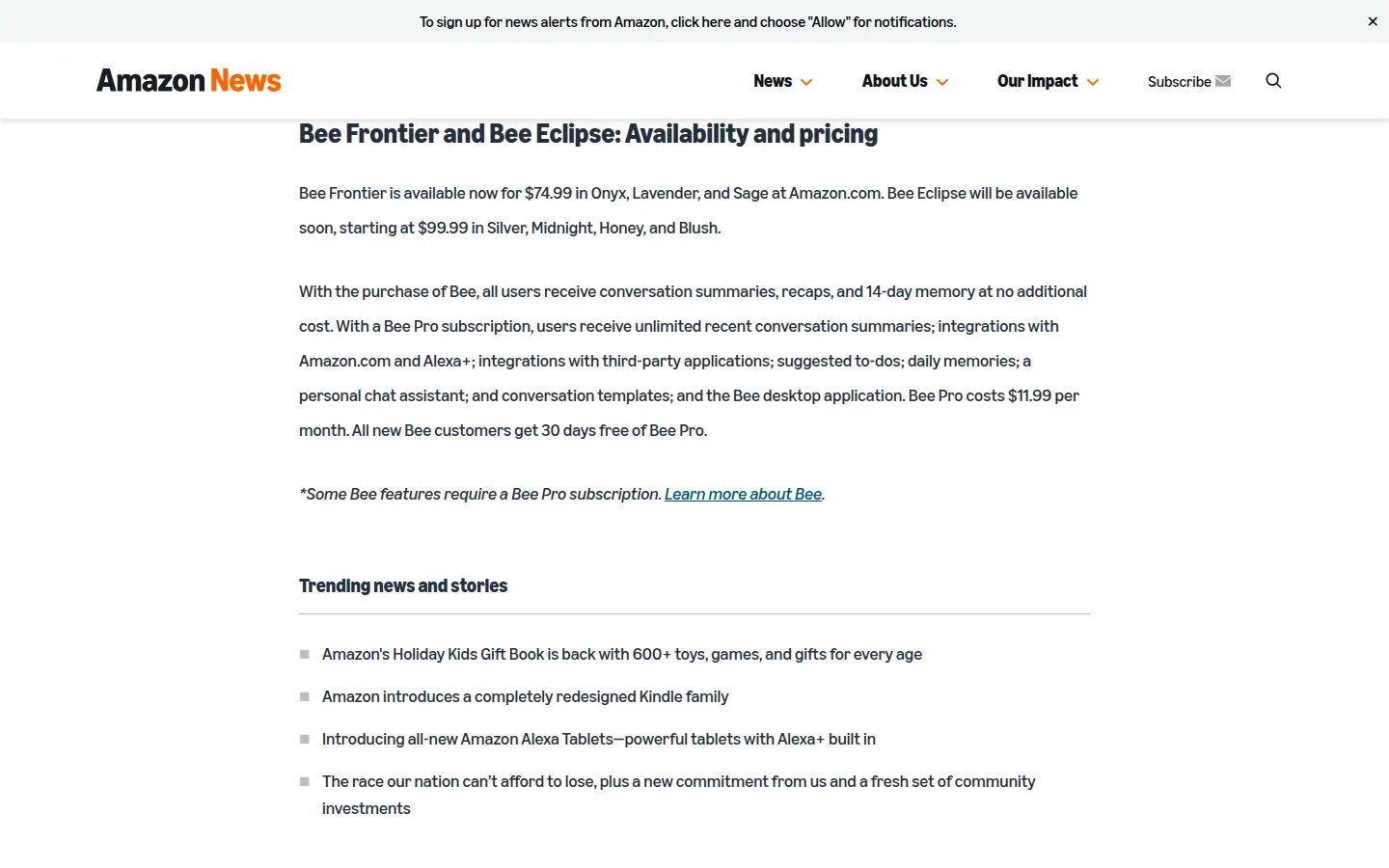
The plastic is the cheaper half of the release. Bee Frontier costs $74.99 and Bee Eclipse starts at $99.99, and the software that makes either of them useful is sold separately at $11.99 a month.
Buying a device gets you conversation summaries, recaps and 14 days of memory at no extra cost, permanently rather than as a trial. Bee Pro adds unlimited recent conversation summaries, integrations with Amazon.com and Alexa+, integrations with third-party applications, suggested to-dos, daily memories, a personal chat assistant, conversation templates, and a desktop application. Amazon writes the consequence in a footnote: some Bee features require a Bee Pro subscription.
| What you pay for | Price | What it buys |
|---|---|---|
| Bee Frontier | $74.99 | The wearable, plus summaries, recaps and 14-day memory |
| Bee Eclipse | From $99.99 | The phone attachment, same free tier, available soon |
| Bee Pro | $11.99 per month | Unlimited recent summaries, Amazon.com and Alexa+ integrations, app integrations, to-dos, daily memories, chat assistant, templates, desktop app |
The page files third-party app integrations inside the Pro plan, and lists Gmail, Google Calendar and Microsoft Outlook among the apps Bee works with. It can surface action items after a meeting, draft a follow-up email or create a calendar invite, and Echo speakers can read Bee summaries out loud once voice ID has recognized the owner. Most of that usefulness sits behind the monthly charge.
What the claim rests on
Everything above comes from one document: a product page dated October 15, 2026, credited to Amazon Staff, with no test unit, no reviewer access and no outside measurement. That is not a criticism of the device, it is a description of the evidence. Nothing on the page states how accurate the transcripts or the summaries are, how often the microphones catch speech that was not meant for them, or what the battery does under continuous recording rather than standby.
What the page does not publish
No accuracy figure for transcription or summaries. No named third-party audit or certification for Bee Private Compute, and no retention rule for what the service keeps once the device has deleted the audio. No launch date for Bee Eclipse beyond available soon. No definition of unlimited recent conversation summaries, the Pro plan’s headline promise. No price in any currency other than the US dollar.
The privacy section is the strongest writing on the page. Amazon states that no audio is ever stored, that audio is processed into insights in real time and deleted afterward, that transcripts are encrypted with keys only the device creates, that a single press turns the microphones on and off with an indicator light showing when they are live, and that users are prompted to get permission from call participants each time a recording starts. Transcripts and summaries can be deleted at any time.
“With the purchase of Bee, all users receive conversation summaries, recaps, and 14-day memory at no additional cost.”
What the page does not offer is a way to take that memory somewhere else. Deletion is promised, export is not mentioned, and the two are not the same commitment. Anyone who builds a year of notes in Bee builds that record inside an Amazon account, on an architecture Amazon describes as isolated and that nobody outside Amazon has examined in public.
On this page
What it changes for anyone choosing an AI subscription
A device plus a subscription is a different shape of cost from a tool you rent by the month. Bee Pro at $11.99 a month lands in the middle of the entry prices we track: Klap starts at $14 per month on an annual plan, Zeemo at $9.99 per month with no commitment, and Bluedot at $18 per user per month on Basic. None of those three asks you to buy a microphone first.
| Tool we track | Entry price | Billing |
|---|---|---|
| Klap | $14 per month | annual commitment, $29 month to month |
| Zeemo | $9.99 per month | monthly, no commitment |
| Bluedot | $18 per user per month | Basic, free to start |
| Bee Pro | $11.99 per month | one person, 30 days free |
The number that decides the purchase is the total, not the subscription. Bee Frontier plus a year of Bee Pro comes to $218.87, and Bee Eclipse plus a year of Bee Pro comes to $243.87. Klap and Zeemo sell an output you can inspect before you renew, while Bee sells memory, which only becomes valuable after months of use. The cost of leaving is the part Amazon leaves unpriced.
There is a real free tier underneath. A Bee device without Pro still transcribes, still summarizes and still keeps 14 days of memory, so the device alone is a complete purchase for short-lived notes. The plan buys the app connections, the desktop application, and memory past the two-week window.
The Neural Minute take
If you are considering Bee, decide on the subscription first, because $74.99 is not the price of the product. Without Pro you are buying a microphone that summarizes two weeks of your life; with Pro you are buying a place in Amazon’s assistant ecosystem at $11.99 a month, the number to compare with the tools you already pay for. Amazon hands you 30 days of Pro with a new device, and that trial is the only test available, since no independent measurement of the accuracy claims exists yet.
We have not used Bee: this is a read of Amazon’s announcement, not a review, and our reviews carry the label that says which kind of page you are on, explained on our method page. What we would want before renewing a year is a real meeting transcribed and checked by hand, and a clear answer on export.
Two things to watch. The first is whether the summaries survive comparison with the Klap and Zeemo tier of tools we track on price and output, since a wearable that recalls a conversation competes with the software people use to record one. The second is the Alexa+ tie: a $74.99 device that feeds an assistant Amazon already charges for is a cheaper way to grow that subscription than selling another speaker.
Sources
- Amazon, Bee Frontier and Bee Eclipse: Introducing new AI wearable and phone attachment, published October 15, 2026, read on October 15, 2026. The date is the page’s own published time, 2026-10-15T11:55:24Z. Every price, battery figure, integration and privacy statement here comes from it.
- Neural Minute, entry prices for Klap, Zeemo and Bluedot, read from each vendor’s own pricing page on October 5, 2026.