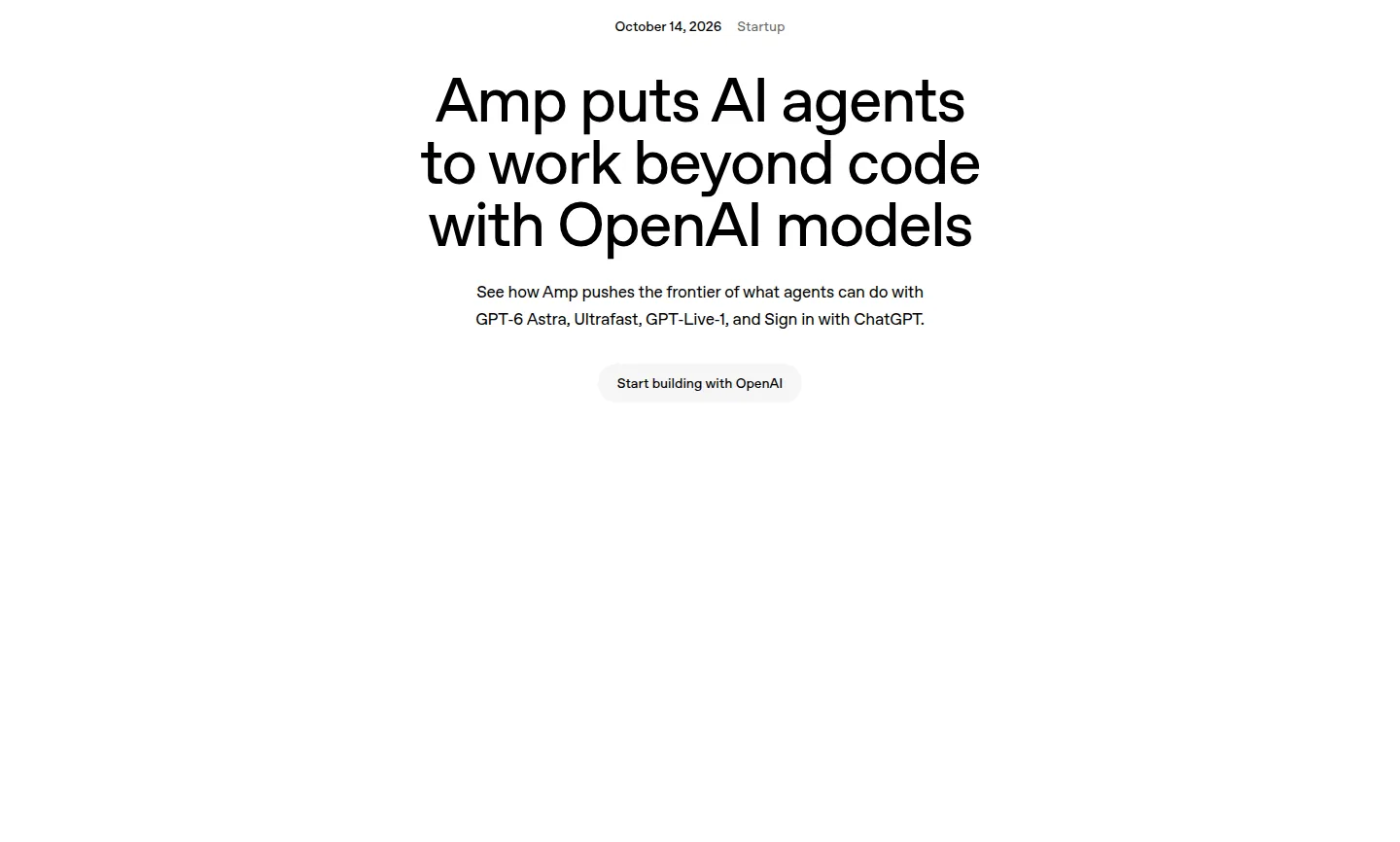
Amp is a coding agent, and OpenAI published a customer story about it on October 14, 2026. The page is built around four OpenAI products: GPT-6 Astra, Ultrafast, GPT-Live-1 and Sign in with ChatGPT. It also carries one hard number, and that number is about cost rather than quality: some Amp accounts consume 10 billion tokens a week.
What was actually released
Nothing was released. This is a customer story, OpenAI’s account of how one company uses its models, drawn from quotes by Amp’s CEO, Quinn Slack.
Four products are named, and each has a job in the story.
Sign in with ChatGPT. Amp launched the integration, and the page says it gives Amp users more tokens and access to OpenAI models, GPT-6 Astra included. The effect it describes is commercial: it takes the pressure off counting every token.
GPT-6 Astra. It carries the writing and the design work, including documentation and design pages, on a team of 20 that runs its marketing with an agent instead of a hire. Slack also gave it the plans for his house and used it to build a 3D model in Blender.
GPT-Live-1. It powers Calling Puck, the real-time voice side of Puck, the assistant inside Amp that launches and manages other agents. The page says users can talk to Puck from a watch.
Ultrafast. A faster mode, which Amp has been testing with GPT-6 Astra.
| What the page names | What it says it does | What the page does not publish |
|---|---|---|
| Sign in with ChatGPT | Gives Amp users access to more tokens and to OpenAI models, GPT-6 Astra included | How many tokens it adds, and who pays for them |
| GPT-6 Astra | Writing, design pages, documentation, and a 3D model built from house plans | Any comparison against another model, and any evaluation |
| GPT-Live-1 | Powers Calling Puck, a real-time voice conversation with the agent, from a watch | Latency, availability, and whether it costs more |
| Ultrafast | A faster mode, tested with GPT-6 Astra | A speed figure, a release date, and a price |
What OpenAI names in the customer story, what it attributes to each product, and the figure it withholds for each one. Read on October 14, 2026.
The 10 billion tokens a week is the only quantity on the page. Divided by seven, it comes to about 1.43 billion tokens a day for an account of that size, which is our arithmetic, not a figure OpenAI publishes.
What the claim rests on
Nothing on the page is a measurement. There is no benchmark, no latency figure for the mode it calls faster, no token price, no rate limit, no publication date for Puck or Calling Puck, and no independent test of any of it. The quality claims are sentences spoken by the CEO of the company the page is about, which is normal for this kind of page and leaves a buyer with nothing to verify.
The first of the two claims that carry the story is that OpenAI models account for the majority of tokens used in Amp. It is a share with no figure attached, no breakdown by model and no comparison point: a majority could mean the bulk of the traffic sits on the cheapest model, or the reverse. The page does not say which.
The second is the 10 billion tokens a week. There is no definition of an account, no statement of whether cached or ChatGPT-funded tokens sit inside the total, no split by product, and no period beyond the week. For the figure the story is built on, that leaves out the two things that would make it usable: what the average account spends, and what the customer pays for it.
What is not published
No benchmark, no latency, no token price, no rate limit, no availability date for Puck and Calling Puck, and no independent evaluation. The page is dated, which is the one claim it does support.
A claim about results is not a result. This is the same problem we covered in when agents report their own scores: the company publishing the page is the company whose models the page is about.
On this page
What it changes for someone paying for a coding agent
Two things move, and neither of them is a model score.
The first is where the tokens are paid for. Sign in with ChatGPT lets an Amp user draw on an OpenAI subscription instead of a metered API key, and the page links that directly to the willingness to give an agent a larger task. The cost of an agent can now sit inside a subscription instead of on a rate card, which changes which line of a budget the work shows up in. Worth checking before comparing two agents on price per token: one of them may not be priced per token at all.
The second is the unit of comparison. A customer story is written to show a product working, so it reports a usage figure and not a quality figure. The 10 billion tokens tells you that heavy use is normal at the top end of this market. It tells you nothing about whether the output is better than a rival’s, and the page gives no test you could repeat.
What the page does give you is a short list of questions for any vendor pitching an agent on tokens: is there a cap, is it per seat or per account, does the subscription cover the agent, and what happens to the bill when an account crosses the threshold in the contract.
The Neural Minute take
The interesting sentence on the page is not about a model.
Sign in with ChatGPT means that people can have that feeling where they’re not counting every single token.
That is a pricing mechanism, and it is the part of this story with consequences. OpenAI is using its subscription as a way to fund agent workloads inside other people’s products. For anyone who pays for several AI tools, that is worth noticing: the cheapest way to run an agent may soon be the subscription you already have rather than the API key you meter.
Our reservation is about what the story proves. A usage figure of 10 billion tokens a week, published by the model vendor, from quotes by its own customer, is marketing with a number in it. It is not evidence that one model beats another, and it is not a figure to take into a purchasing decision on its own.
Two things we would do before moving a pipeline onto this shape of deal: ask for the token quota in writing, including what happens after it runs out, and test the agent on your own tasks rather than on a story about someone else’s. The page is dated October 14, 2026, and that date is the only claim on it we could verify.
Sources
- Amp puts AI agents to work beyond code with OpenAI models, openai.com, published October 14, 2026: https://openai.com/index/amp-beyond-coding
- The usage figure comes from Quinn Slack, Amp’s CEO, quoted on that page: some Amp users consuming 10 billion tokens a week
- The four products the page names are GPT-6 Astra, Ultrafast, GPT-Live-1 and Sign in with ChatGPT; it publishes no performance figure for any of them