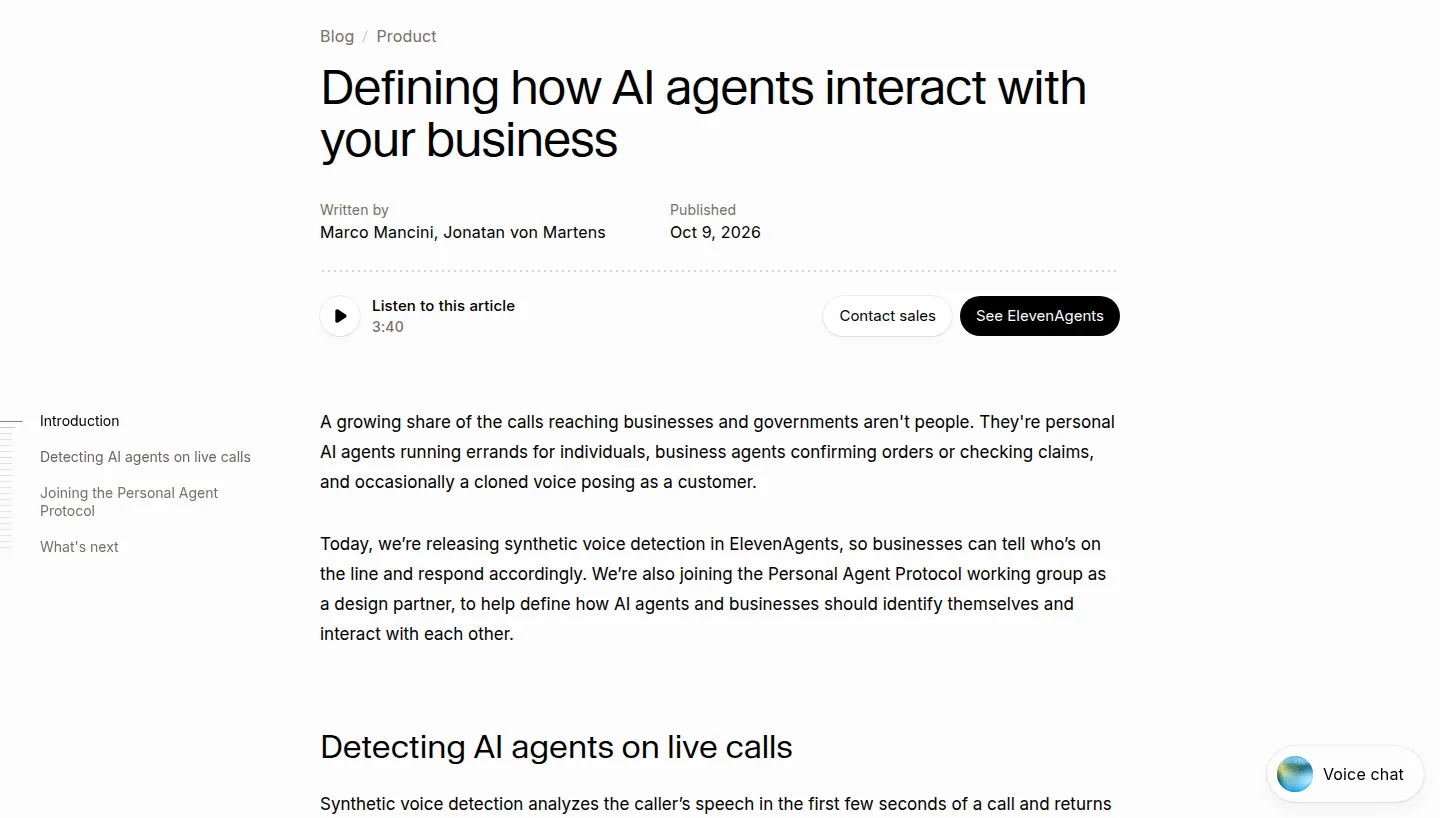
ElevenLabs released synthetic voice detection inside ElevenAgents on October 9, 2026, and said it is joining the Personal Agent Protocol working group as a design partner. The feature listens to the first seconds of an inbound call and returns a determination, human or AI generated, then applies whatever rule the business has set for that result.
What was actually released
Synthetic voice detection runs inside ElevenAgents, on the live audio stream of a call, and it does not wait for the call to finish. ElevenLabs says it looks for traces a human listener would not notice but software can, and it returns one of two answers within the first few seconds. From there the business, not the agent, decides what happens.
Three rule patterns are given as examples, and they carry more of the release than the detector itself.
| What the detection finds | What the business can set | What it changes |
|---|---|---|
| A verified human | The front of the queue, a human representative or the most capable agent, and the room to negotiate a bill or apply a retention offer | Judgment stays with a person when the call is complex |
| A machine agent | An agent with its own instructions and limits: it authenticates first, then answers within scope | Machine calls complete quickly and can sit lower in the queue while people wait |
| A cloned or synthetic voice | A stop before the caller reaches information or takes an action, such as a bank account change or a password reset | Impersonation is blocked at the start of the call instead of after it |
The product detail that matters is what the detection does not rely on. ElevenLabs writes that audio generated with its own tools carries a watermark, but that audio from other sources often does not, so the detector cannot depend on finding one. That sentence is the honest version of the feature: it is a classifier reading the audio, not a check against a mark the caller was supposed to carry.
The second half of the announcement is not a product at all. ElevenLabs is joining the Personal Agent Protocol as a design partner, in a working group it says is led by Meta and Sierra. The protocol is described as defining how a personal agent identifies itself to a business, who it represents, and what it is allowed to do on that person’s behalf. ElevenLabs says it already deploys agents across phone, website, in-app experiences, email, WhatsApp and SMS, and wants every channel to answer to the same identity rules.
Availability is stated in two steps. Today, the detection goes to enterprise customers supported by the Forward Deployed Engineering team. Later this month it becomes a configurable option inside ElevenAgents for a broader group of enterprise customers. No price is attached to either step.
What the two halves have in common
One is a detector that classifies a caller as human or machine. The other is a draft standard for a machine to declare itself. A business needs the second to trust the first at scale: a classifier that guesses must carry an error rate, while an agent that identifies itself does not guess.
What the claim rests on
The claim that a call can be sorted in its first few seconds rests on a detector whose accuracy ElevenLabs does not publish. There is no false-positive rate, no false-negative rate, no language list, and no measurement for how fast those seconds are. For a control that decides who reaches the front of a queue, that is the first number a buyer would want, and it is missing.
The protocol sentence rests on even less, because it is not a release but a working group led by Meta and Sierra with ElevenLabs as a design partner. A standard at that stage is a direction of travel, not a specification a buyer can build against today.
What can be read plainly is the design: detection without a watermark is detection without a shared secret, so the call is judged on its audio alone.
What is not published
No accuracy figures, no false-positive or false-negative rate, no language coverage, no latency number beyond the words first few seconds, no price, no list of which enterprise plans receive it, and no date beyond later this month for the wider rollout. The protocol comes with no timeline, no membership beyond the group named, and no draft text.
On this page
What it changes for a business putting agents on the phone
If you run a phone line where agents already answer, the release adds a switch that did not exist: the call can be sorted before it is handled. The front-of-queue rule is the one most teams will reach for first, because it protects the outcome that is easiest to lose, a paying customer who cannot reach a person.
The services reading is different. A business that lets machine callers negotiate has to write a scope for that agent, and the release makes that scope the business’s decision rather than the vendor’s default. That is more work than before, and it belongs to whoever owns the phone line.
The third effect is on fraud. Stopping a synthetic voice before it reaches a bank account change or a password reset moves the control to the start of the call, which is earlier than most identity checks sit today. Earlier is worth more in a call than exact later.
The Neural Minute take
None of our own tool pages is ElevenLabs, so there is no verified price of ours to hold this release against, and we will not borrow one from elsewhere to fill the gap. What we do have is the low end of agent pricing, where the trend runs the other way. Our own reading of Agentik puts the platform fee on top-ups above $10 at 5.5% with a $0.80 floor, checked on October 5, 2026, and Context.dev prices 7,500 credits at $19 a month, checked on October 4, 2026.
All audio generated with ElevenLabs carries a watermark, but audio from other sources often doesn’t, so detection doesn’t depend on one being there.
That line is why we read this as the start of an identity problem rather than an answer to one. A detector with no published error rate is a classifier, and a classifier that decides who reaches the front of a queue has to be bought on its error rate, not its demo. The watermark sentence says the company already knows the mark cannot be trusted as proof, which is the admission that makes the accuracy number load-bearing.
Our note for a buyer is short. Ask for the false-positive rate and the languages before you route a single real call through it, because a person misread as a machine loses the placement the rule was built to protect. And treat the Personal Agent Protocol as a signal to watch, not a thing to build on: a standard written by the agents’ own vendors is a promise about the future, and the detector is what you can test today.
Sources
- Defining how AI agents interact with your business, ElevenLabs blog, published October 9, 2026: https://elevenlabs.io/blog/synthetic-voice-detection-and-personal-agent-protocol
- The detection behavior, the three rule examples, the watermark statement, the protocol participation and the two-step availability are read on that page on October 9, 2026, as ElevenLabs’ own statements, not independent measurements
- Prices for Agentik and Context.dev come from our own verified readings, dated October 5 and October 4, 2026, not from any third party