Google Cloud announced the Gemini agent on October 8, 2026, at its Gemini at Work 2026 event, describing it as a single universal agent for work. In the company’s words it answers questions, handles knowledge work, creates images and media, and writes and runs code from one prompt box, inside the Workspace applications a company may already pay for.
What was actually released
One agent behind one API. Google presents an agent that is given an objective rather than a list of instructions, and that returns finished work inside the tools a team already uses. Inside Workspace it works inline in Gmail, Drive, Docs, Slides, Sheets, Chat, and Calendar, carrying the same memory, skills, and controls across all of them.
Reach is wider than Google’s own applications: the announcement lists web, iOS and Android, Windows and Mac desktops, a command line, Microsoft 365, and Slack, plus a headless mode for third-party surfaces.
Execution is persistent. Google says the agent runs in the cloud with a single set of memories, context, and one personalization graph across devices, so work that takes hours or days keeps running after the laptop is closed. It names four kinds of memory: session, semantic, procedural, and episodic.
Three additions that matter more than the feature list
- Sub-agents: temporary, job-specific agents with their own identities, for parallel and sequential steps that can last hours or days.
- Coworker agents: a persistent role that receives its own Workspace account, an address on the pattern @agents.company.com, a calendar, Drive storage, and a presence in the company directory. It acts under its own identity rather than the user’s.
- Spend caps: an administrator can set a hard limit on a project’s AI spend in the Cloud Billing Console, and when the cap triggers that project’s agent pauses until someone resumes it. Tracking is per project, which lets a company charge AI costs back to a department.
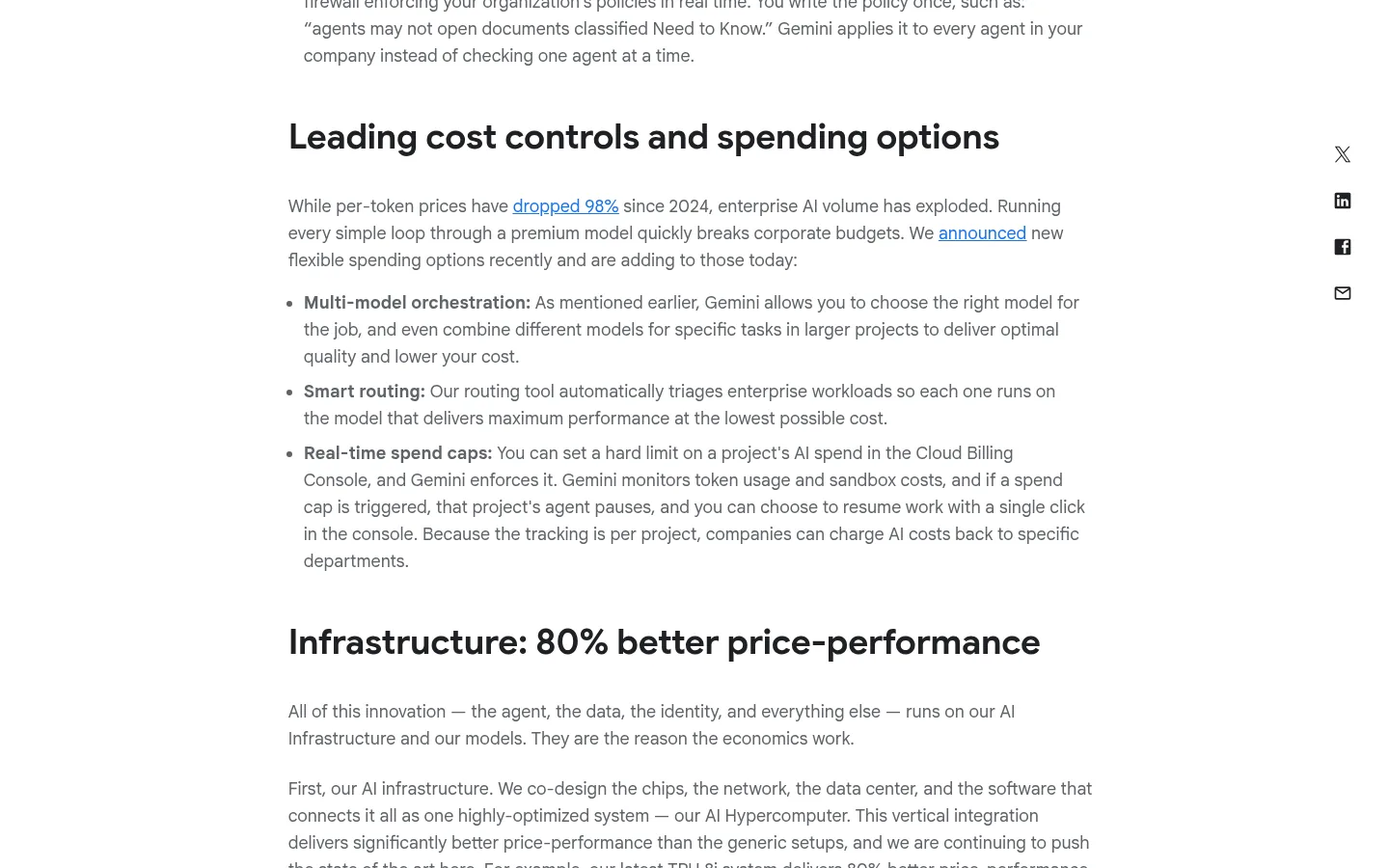
The model underneath is a separate choice. Google says the agent orchestrates across its Gemini family and Claude models from Anthropic today, with other private and open models described as future additions, and that a routing layer called Smart Routing triages each workload to the model that fits it.
Connectors are listed for Confluence, Microsoft Office, Teams, Slack, Git, Jira, Salesforce, ServiceNow, BigQuery, Databricks, Postgres, Snowflake, and any Model Context Protocol server, with tools and skills publishable to company registries. Industry packs for financial services and legal are in preview, with government, healthcare, and retail listed as coming soon.
What the claim rests on
The adoption numbers are Google’s own and unaudited. The post states five figures, none of them with a definition, a period narrower than the last year, or a check by anyone outside Google.
| Figure Google states | What it covers | Independent check |
|---|---|---|
| Nearly 500 customers above one trillion tokens | the last year, counted by Google | none published |
| Nearly 80% of Google Cloud customers use its AI products | no definition of using | none published |
| Nearly 90% of the Fortune 100 use Gemini Enterprise | no period stated | none published |
| Per-token prices down 98% since 2024 | no baseline model named | none published |
| PayPal: 10 million multi-model requests a week | one customer, supplier account | none published |
The customer results rest on the same footing. Bradesco is said to have cut document review from one hour to five minutes with 60% fewer risk inconsistencies, SOMPO to have cut model development from one week to a day across 10,000 internal agents, and an agent at Bunnings to have saved half a million hours of administrative work. Each is a customer’s own account, published by its supplier, without a stated methodology, a baseline, or independent verification.
One comparative figure deserves care. Google writes that per-token prices have dropped 98% since 2024, the seller’s framing, with no baseline model named and no accounting for the heavier tasks agentic work introduces next to a chat.
What is not published
There is no price for the Gemini agent, no list of which Workspace plans include it, no general availability date, and no region list. Smart Routing and the spend caps come with no published defaults or limits, and no API rate limits, quotas, or latency figures appear anywhere in the post. The 80% better price-performance claimed for the new TPU 8i is measured against Google’s prior generation, on Google’s own comparison.
On this page
What it changes for teams paying for AI tools
The model moves from a procurement decision to a runtime one. A team that buys one premium model seat today is being offered a layer that picks the model per task and caps the total spend, which is a different purchase: an outcome and a ceiling rather than a model.
The ceiling is the more useful half. A hard cap that pauses the agent is an operational control, and the pause-and-resume behavior is what decides whether the agent can be left unattended. An agent that stops at a limit can be put through a finance approval; an agent that only warns has to be watched by a person.
Agent identity is the third change, and it is administrative before it is technical. A coworker agent with its own mailbox, calendar, and directory entry has to be provisioned, governed, and accounted for like a member of staff, which pushes the questions of seats and permissions to whoever signs the invoice.
The Neural Minute take
None of the 17 tools in our own base is Google Gemini, so there is no verified price of ours to hold this announcement against. That is worth saying plainly: what this agent costs sits entirely on the vendor’s side of the table, and our note on it stays empty because Google published nothing to fill it with.
A vendor that states its agent orchestrates across its own models and Claude models from Anthropic, and keeps the choice open for models it has not named, is unbundling the model from the agent it sells.
That is the part that changes a buying decision, and it is why the model price moves we covered this week, Haiku 5.5 at $0.10 per million input tokens, are not side stories for anyone buying agents rather than chatbots.
What we do have on our side is the low end of agent pricing, where the same problem is already solved the other way, with a meter instead of a ceiling.
| Reading of ours | Price | Read on |
|---|---|---|
| Agentik | 5.5% fee on top-ups above $10 | October 5, 2026 |
| Context.dev | $19 a month for 7,500 credits | October 4, 2026 |
Per-call and credit pricing exists because agent work is hard to forecast, and the Gemini announcement is that problem arriving at enterprise scale.
What we would want before moving a team onto it: the price, whether it is a separate line or folded into a Workspace plan, the general availability date, and whether a spend cap stops the agent or merely flags it. The last point is not a detail. It is the difference between paying for an agent and supervising a budget.
Sources
- Welcome to Gemini at Work 2026: Introducing the Gemini agent, Google Cloud blog, published October 8, 2026: https://cloud.google.com/blog/products/ai-machine-learning/welcome-to-gemini-at-work-2026
- Adoption figures, customer results, the 98% per-token line, the routing and spend cap behavior, and the TPU 8i comparison are read on that post on October 8, 2026, and reproduced as the vendor’s own statements, not as independent measurements
- Prices for Agentik and Context.dev come from our own verified readings, dated October 5 and October 4, 2026, not from any third party