Mistral published “Introducing Mistral Large 4” on October 6, 2026, and put the model behind a public preview the same day. The article calls it ML4 and, unofficially, le Chonk.
What was actually released
A public preview of Mistral’s biggest model, reachable through Mistral Studio and the API. Not the weights: the article states that the weights drop at the end of this month, and that the architecture details, the additional benchmarks and the post-training method will be published then.
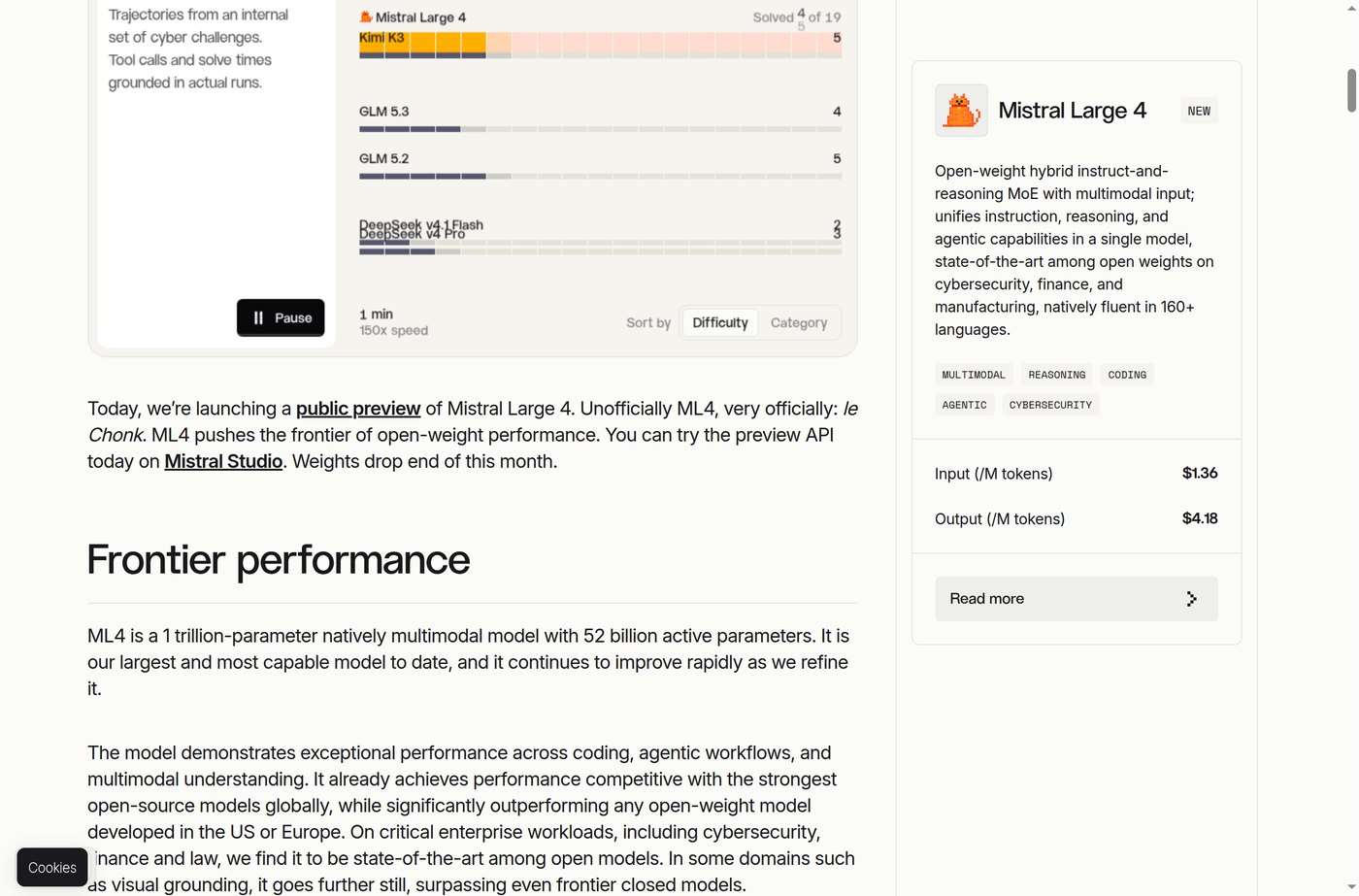
The model itself is a 1-trillion-parameter hybrid instruct-and-reasoning mixture of experts, with 52 billion active parameters, natively multimodal input, and, according to Mistral, fluency in more than 160 languages, including every official language of the European Union.
Two operational details come with it. It was trained from scratch on 3,800 NVIDIA Grace Blackwell GPUs in Mistral’s own European datacenters, and the preview is served on that same infrastructure, with a European deployment operated end to end and independent of other digital service providers. And the preview is running with reduced moderation and expanded cyber capabilities for vetted partners, cybersecurity leaders and state authorities, which is a red-teaming arrangement rather than a general release.
What the claim rests on
Three sets of numbers are published, and they do not carry the same weight.
The price is a fact. The model card on the same site lists $1.36 and $4.18 per million tokens. For comparison, Claude Sonnet 5.5 was listed at $2 input and $10 output on October 8, and Claude Opus 5.5 at $4 and $20. Mistral’s flagship therefore lands below the closed mid-tier on both sides, which is unusual for a model being sold on frontier performance.
| Model | Input, per million tokens | Output, per million tokens | Rates read on |
|---|---|---|---|
| Mistral Large 4, preview | $1.36 | $4.18 | mistral.ai, October 8, 2026 |
| Claude Sonnet 5.5 | $2 | $10 | claude.com/pricing, October 8, 2026 |
| Claude Opus 5.5 | $4 | $20 | claude.com/pricing, October 8, 2026 |
Both rivals are closed models, so the table compares a published rate against published rates, not like for like on what you are allowed to do with the model.
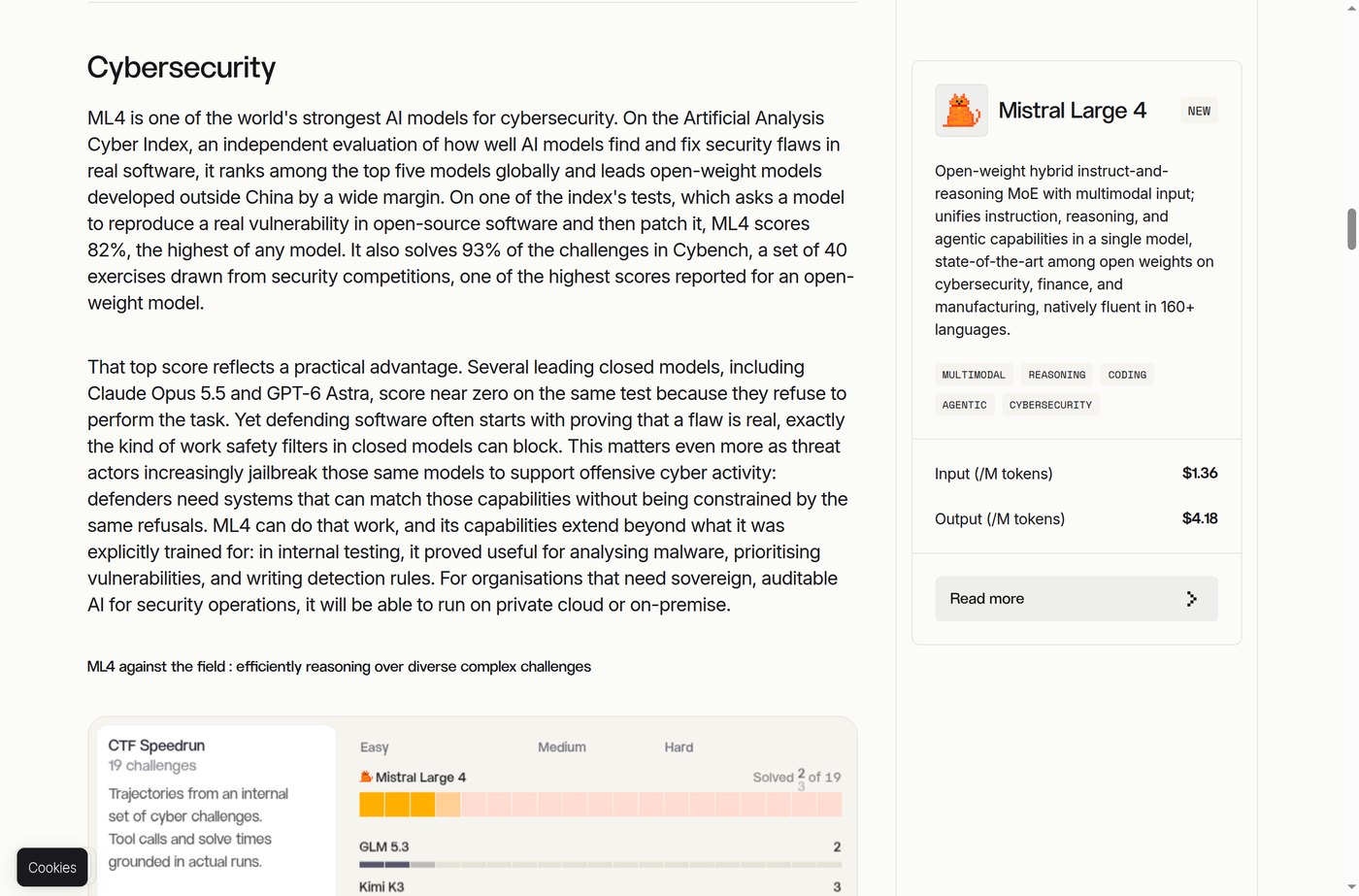
The cybersecurity results are partly comparable, partly not. On the Artificial Analysis Cyber Index, an evaluation run by a third party, Mistral says the model ranks among the top five globally and leads open-weight models developed outside China. On one index test that asks a model to reproduce a real vulnerability in open-source software and then patch it, ML4 scores 82%, which Mistral says is the highest of any model, and it solves 93% of the challenges in Cybench. Mistral then writes that several leading closed models, including Claude Opus 5.5 and GPT-6 Astra, score near zero on the same test because they refuse to perform it.
A comparison in which the alternative is filtered out by its own policy is not a comparison of capability; it is a comparison of what each model is allowed to do.
Both readings are true, they are just not the same claim. The published scores are worth reading as “this model will do the work”, not as “this model is better at the work”.
The remaining figures are the company’s own, on its own harness: 61.7% on DeepSWE v1.1, 59.4% on SWE-Atlas-QnA and 28.3% on Terminal-Bench 4.0. Nothing was independent there, and no third party has published a replication.
What is not published
No context window, no latency figure, no rate limits, no service level, no date for general availability beyond “end of this month”, and no indication of the license the weights will carry. On an open-weight pitch, the license is not a detail: it decides whether a company can ship the model inside its own product.
On this page
What it changes for someone choosing a model
If you pay for AI inference, two things move the day the weights land, and neither is true today.
The two things that move when the weights land
- The price floor. A 1-trillion-parameter open-weight model priced at $1.36 and $4.18 forces the closed mid-tier to justify its multiple. That pressure is real in the API market already, and it will reach self-hosted setups as soon as the weights are downloadable.
- What you can do with it. Today you can call a preview. You cannot download the model, run it on your own hardware, fine-tune it, or ship it in a product. Everything the announcement says about sovereignty, audit and on-premises deployment depends on a release that has not happened.
For a team with a European data-residency requirement, the Mistral pitch is the infrastructure, not the benchmark: their own datacenters, and a deployment they operate independently. That part is verifiable today, from the API side, by anyone who signs up.
The Neural Minute take
Our reading is that the interesting line in this announcement is not the 82%, it is the sentence that comes after the numbers.
Mistral is selling a cyber capability that closed models deliberately refuse, and it is right that a defender needs a model that will not refuse when the task is to prove that a flaw is real. That argument stands on its own and does not need a benchmark table. Presenting it as a score where competitors show near zero makes the case weaker, not stronger, because the reader cannot tell whether the gap is capability or policy.
The second thing we would tell a reader who pays for inference: treat the preview as a two-week test, not a migration. Call it with your own prompt set, compare it against whatever you pay today at the same price point, and write down the result, because the weights and the license at the end of the month can change the answer completely. If your use case needs the model on your own hardware, nothing is available to test yet, and no price is committed.
One detail worth quoting to whoever signs the purchase order: at 3,000 GPUs, Mistral says a single training run produces roughly 33 billion tokens a day, of which about 16 billion are trainable completion tokens after filtering. That is a statement about their pipeline, and it also tells you the model’s next version will arrive quickly.
Sources
- Introducing Mistral Large 4, mistral.ai, published October 6, 2026, updated October 7, 2026: https://mistral.ai/news/mistral-large-4/
- The model’s published rates, read on the same page on October 8, 2026: $1.36 per million input tokens, $4.18 per million output tokens
- Claude pricing for comparison, read on October 8, 2026: Sonnet 5.5 at $2 input and $10 output, Opus 5.5 at $4 input and $20 output, per million tokens
- The Artificial Analysis Cyber Index and Cybench figures are Mistral’s own reading of those evaluations, quoted as such; no independent replication was found