Anthropic announced Claude Haiku 5.5 on October 7, 2026, describing it as the cheapest, fastest and most capable small model it has released. It is available now.
What was actually released
A small model, positioned for high-volume and cost-sensitive work: summaries, context compactions, database queries, classification. Anthropic also presents it as a subagent to pair with Opus 5.5 and Sonnet 5.5 on coding work, and as a fit for speed-sensitive tasks such as live customer support and browser use.
Two features matter beyond the model itself: both change an existing bill rather than adding a new line.
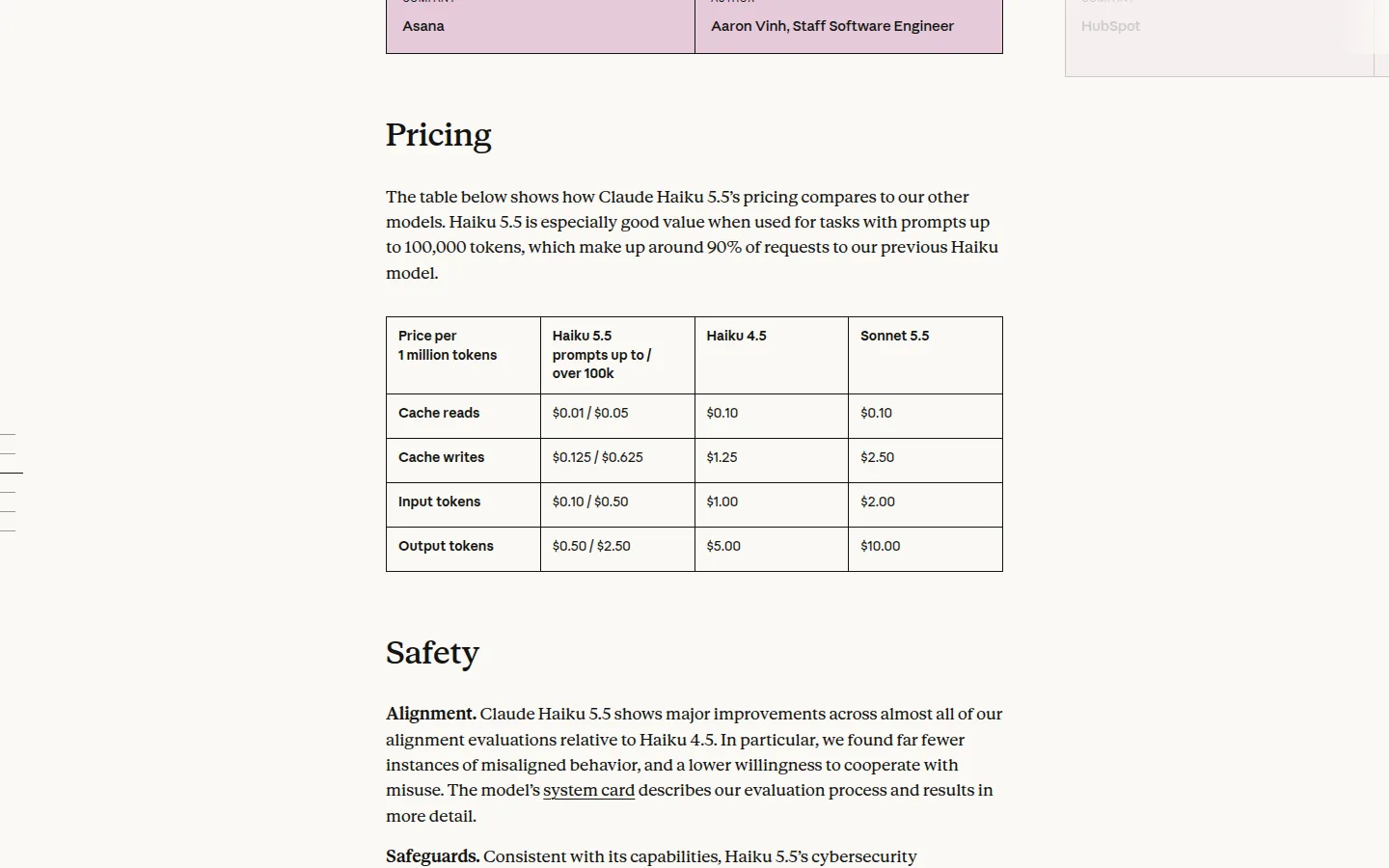
The first is the price. On the published rate card, Haiku 5.5 is $0.10 per million input tokens and $0.50 per million output tokens for prompts up to 100,000 tokens, rising to $0.50 and $2.50 above that threshold. Cache reads are $0.01 per million, writes $0.125. Against the same page, Sonnet 5.5 is $2 and $10, and Opus 5.5 is $4 and $20: the new small model is twenty times cheaper than the mid-tier on both input and output.
The second is the effort setting. Haiku 5.5 is the first Haiku-class model with an adjustable effort dial, running from a low setting to a maximum one, which lets the same model be used cheaply for classification and expensively for a hard reasoning step. The page publishes the accuracy-versus-cost curves for computer use, knowledge work and reasoning at each level.
| Model | Input, up to 100K tokens | Output, up to 100K | Input, over 100K | Output, over 100K | Cache read |
|---|---|---|---|---|---|
| Claude Haiku 5.5 | $0.10 | $0.50 | $0.50 | $2.50 | $0.01 |
| Claude Sonnet 5.5 | $2 | $10 | Single rate | Single rate | $0.10 |
| Claude Opus 5.5 | $4 | $20 | Single rate | Single rate | $0.20 |
Rates per million tokens, read on the published price page on October 8, 2026. Only Haiku 5.5 carries a threshold at 100,000 tokens: past it, its input rate is multiplied by five and its output rate by five, which puts a long-context agent in a different bracket from the sticker price.
Anthropic also announced two changes around the model: cache reads for Sonnet 5.5 are halved, which the page says makes Sonnet 5.5 around 20% cheaper on most agentic work, and a new monthly API credit is introduced for Claude Max and Team subscribers.
What the claim rests on
The headline comparison is not verifiable on the pages Anthropic points to. The announcement says Haiku 5.5 costs around 75% less to run than Haiku 4.5, on average. The published rate card lists only current models: Haiku 4.5 no longer appears among them, so the 75% cannot be checked from the company’s own price page on the day of release. It may well be right; it is a figure you have to take on trust, and it is worth asking for the basis if a purchase depends on it.
The benchmark table, by contrast, is explicit about what it compares. Every figure is given against Haiku 4.5, against a competitor listed as GPT-6 Luna, and against Sonnet 5.5:
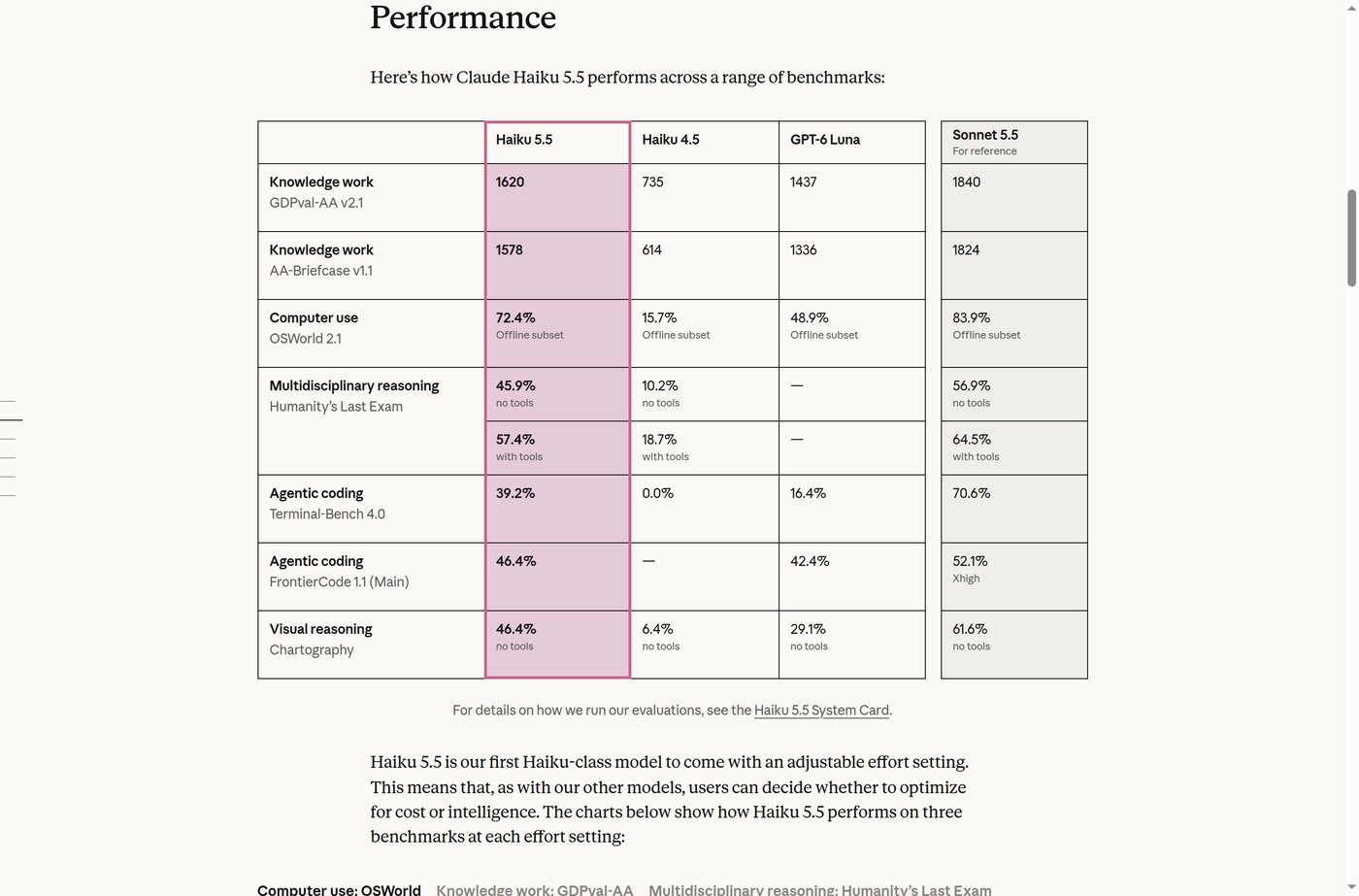
| Benchmark | Haiku 5.5 | Haiku 4.5 | GPT-6 Luna | Sonnet 5.5 |
|---|---|---|---|---|
| Knowledge work, GDPval-AA v2.1 | 1620 | 735 | 1437 | 1840 |
| Knowledge work, AA-Briefcase v1.1 | 1578 | 614 | 1336 | 1824 |
| Computer use, OSWorld 2.1, offline subset | 72.4% | 15.7% | 48.9% | 83.9% |
| Reasoning, Humanity’s Last Exam, no tools | 45.9% | 10.2% | not given | 56.9% |
| Reasoning, Humanity’s Last Exam, with tools | 57.4% | 18.7% | not given | 64.5% |
| Agentic coding, Terminal-Bench 4.0 | 39.2% | 0.0% | 16.4% | 70.6% |
| Agentic coding, FrontierCode 1.1, main track | 46.4% | not given | 42.4% | 52.1% |
| Visual reasoning, Chartography, no tools | 46.4% | 6.4% | 29.1% | 61.6% |
Figures published by Anthropic on the announcement page, read on October 8, 2026, and reproduced here as the company’s own runs, not as an independent measurement.
These are the company’s own runs, on its own harness, published with a system card. That is the standard for a model release, and it is not a neutral measurement: no independent replication appeared with the launch.
The number in that table worth keeping
The previous model scoring 0.0% on Terminal-Bench 4.0 does not mean it failed gradually. It means the task class was beyond it. The jump from 0 to 39.2% describes a small model crossing into a category of work where it previously could not compete, which is a bigger change than the same delta would be at the frontier.
What is not published
No context window figure on the announcement page, no latency measurement for the promise of being the fastest model, no rate limits, and no independent evaluation.
On this page
What it changes for someone paying for agents
A twenty-fold gap between the small model and the mid-tier changes how an agent pipeline should be built, and the effort dial is the part that is genuinely new.
Until now the practical pattern was to route everything to one mid-tier model, because a cheap model that fails silently costs more than it saves. With a published effort setting, the same model can be given a low setting for classification and routing, and a high one for the hard step in the chain, with the cost curve printed in advance. That is a planning tool, not just a discount.
The second effect is on subagents. If a coding agent spawns helper models for search, extraction or verification, those calls were previously priced against the mid-tier. At $0.10 input, the arithmetic for running many small calls changes by an order of magnitude, which is what makes some agent designs affordable that were not before.
The third is the Sonnet cache change. Any team running an agentic loop on Sonnet 5.5, where the same long context is re-read on every step, should look at its cache-read line, because that is where the 20% lands.
The Neural Minute take
The interesting number here is not 1620 or 72.4%. It is $0.10.
It moves the decision from which model to which setting, at which step.
That is what an adjustable effort dial does, and it matters more than another benchmark win for anyone building agents.
Our reservation is about the claim we could not check. The 75% figure is the one a buyer will repeat, it is the one the announcement leads with, and it is the one the company’s own price page cannot confirm on release day. When a discount is the news, the arithmetic should be shown, and here it is not: no Haiku 4.5 rate, no average usage profile, no basis for the average. Ask for it in writing before you sign, exactly as you would with any supplier quoting a percentage saving.
Two things we would check before moving a pipeline: whether the effort setting is exposed in the API you actually call, and where the 100,000-token threshold sits for your prompts, since crossing it multiplies the input price by five and the output price by five. For a long-context agent, that threshold, not the sticker price, decides the monthly figure.
Sources
- Introducing Claude Haiku 5.5, anthropic.com, published October 7, 2026: https://www.anthropic.com/claude-haiku-5-5
- The published rates, read on the pricing page on October 8, 2026: $0.10 per million input tokens and $0.50 output up to 100,000 tokens, $0.50 and $2.50 above; cache reads $0.01, writes $0.125; Sonnet 5.5 at $2 and $10; Opus 5.5 at $4 and $20
- The system card referenced by the announcement is the source for the benchmark methodology; the figures quoted here are the company’s own runs