Virlo’s pitch is narrow and sensible: stop counting views, start counting surprises. A video with 40,000 views is a flop for an account that does that every day and a hit for one that usually gets 800. The tool promises to find those videos in your niche, explain the hook, and hand you a script.
That is a real gap in the short-form market, and it is why the tool deserves a look. What follows is what an audit without an account can and cannot establish, and the second list is much longer than the first.
What Virlo does
The home page describes three steps: set up a research agent with one sentence, examine the hooks, formats and angles of the videos it surfaces, then produce a script, a brief or a report. TikTok, Instagram Reels and YouTube Shorts are the sources named.
The example videos shown on the site, under the Poppi name, are the company’s own demonstrations rather than results of a user run, which is worth saying plainly: they are marketing material.
Beneath the interface, an API is presented as a separate product, billed by usage, that can be used without an application subscription. It was not called in this audit.
What you get for the money
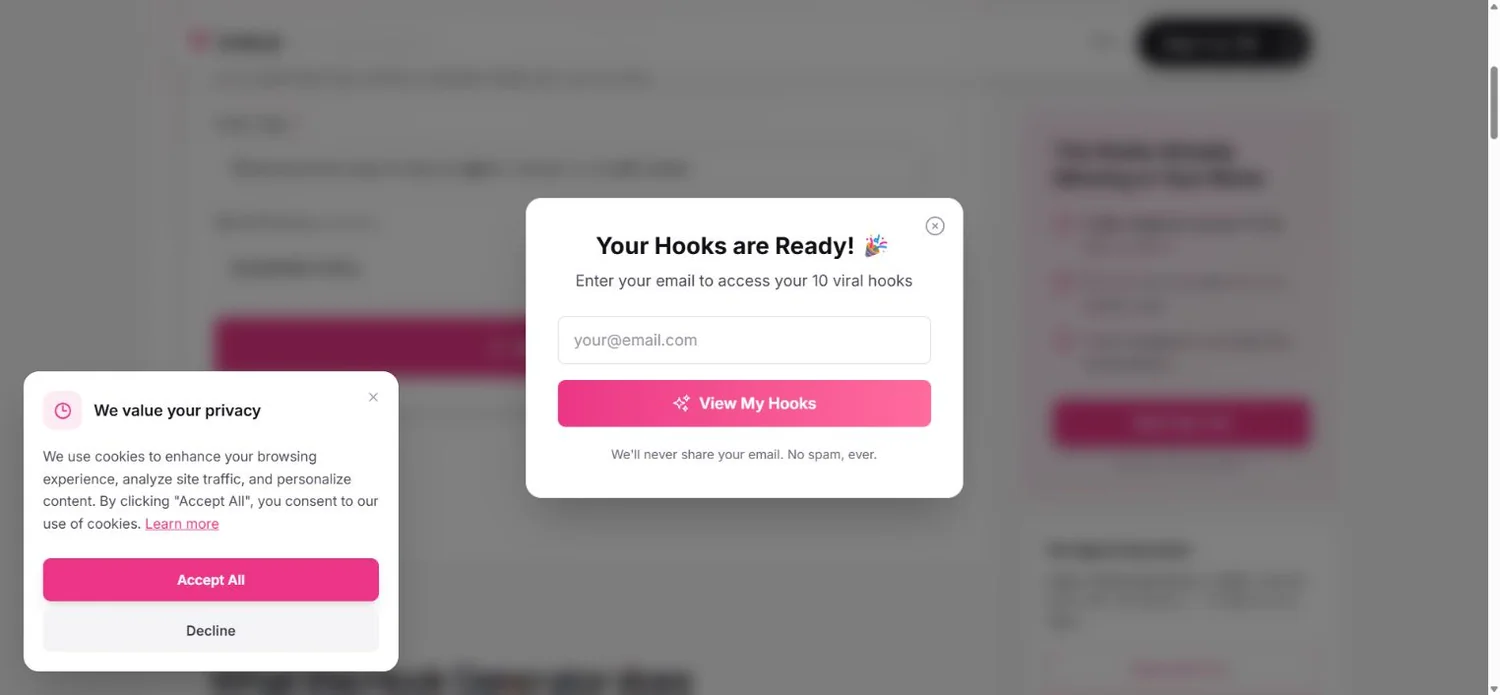
| Plan | Monthly | Annual | Credits |
|---|---|---|---|
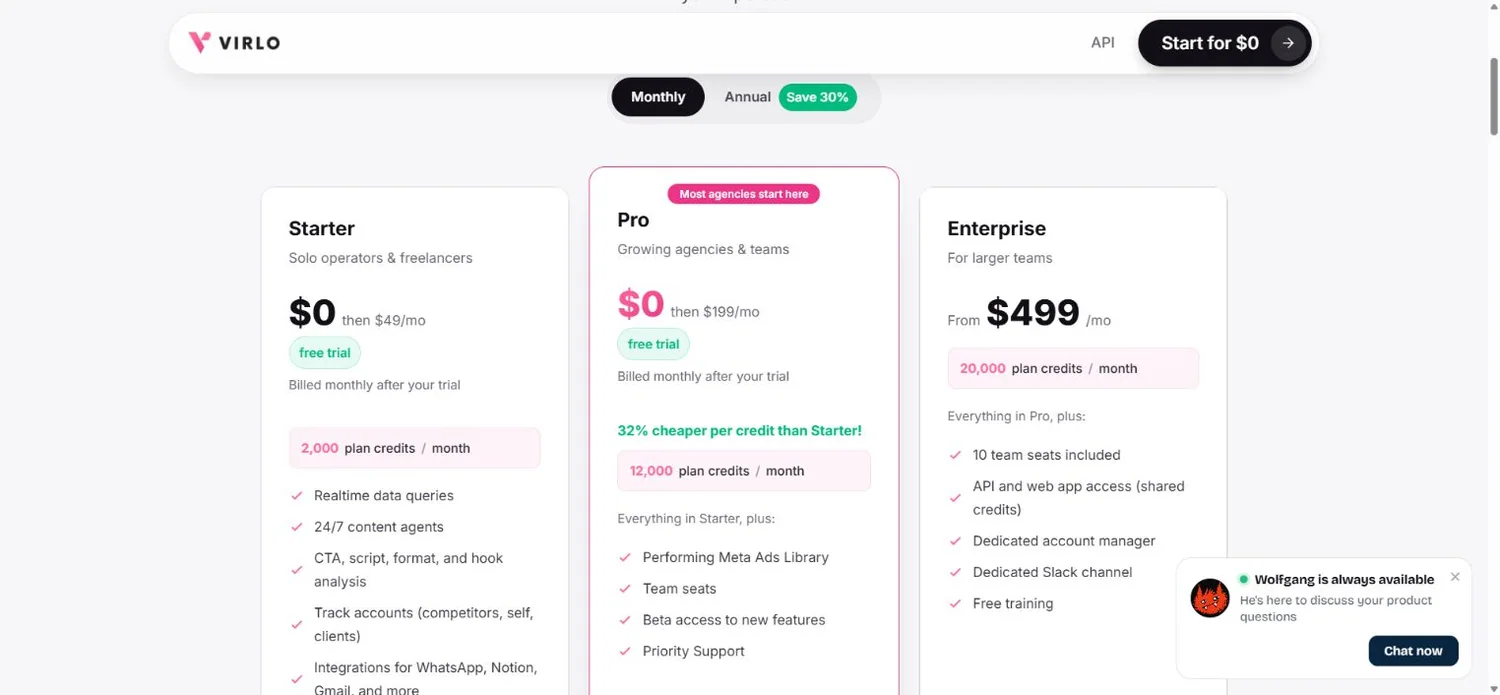
| Starter | $49/mo | $34/mo equivalent, $408 billed a year | 2,000/mo |
| Pro | $199/mo | $139/mo equivalent, $1,671.60 billed a year | 12,000/mo |
| Enterprise | from $499/mo | on request | 20,000 announced |
The FAQ is unusually explicit about what an operation costs: 100 credits for an agent run, 15 credits for the daily collection of one creator, 10 for the daily collection of one video.
Do the arithmetic before choosing a plan, because it is where the pricing gets interesting. A daily agent run over thirty days costs 3,000 credits, which already exceeds the whole Starter quota of 2,000. Following one creator and one video daily costs 750 credits a month, leaving 1,250 on Starter, enough for twelve further runs. If every credit went to agent runs, Pro works out around $1.66 per run against $2.45 on Starter. Those are plan allocations, not a price per action, and nothing guarantees a run returns something you can use.
On this page
Where it falls short
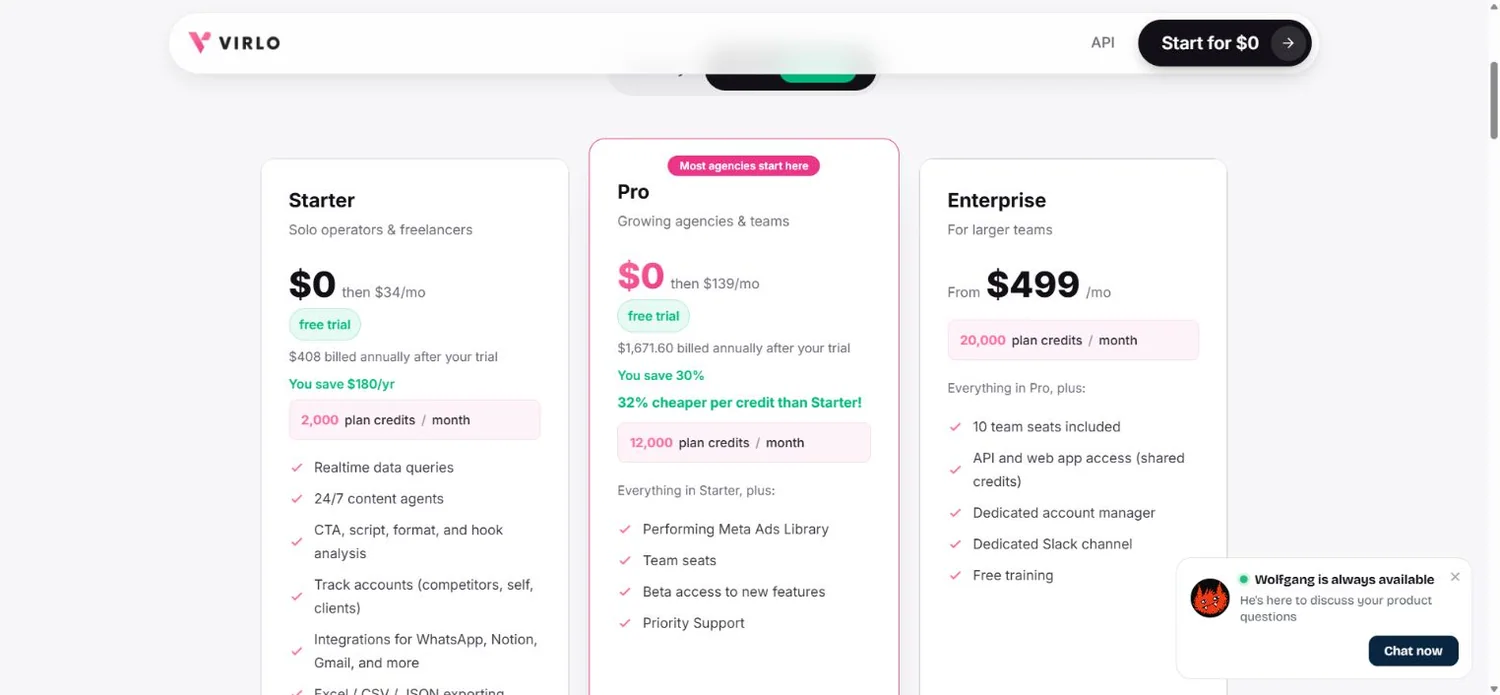
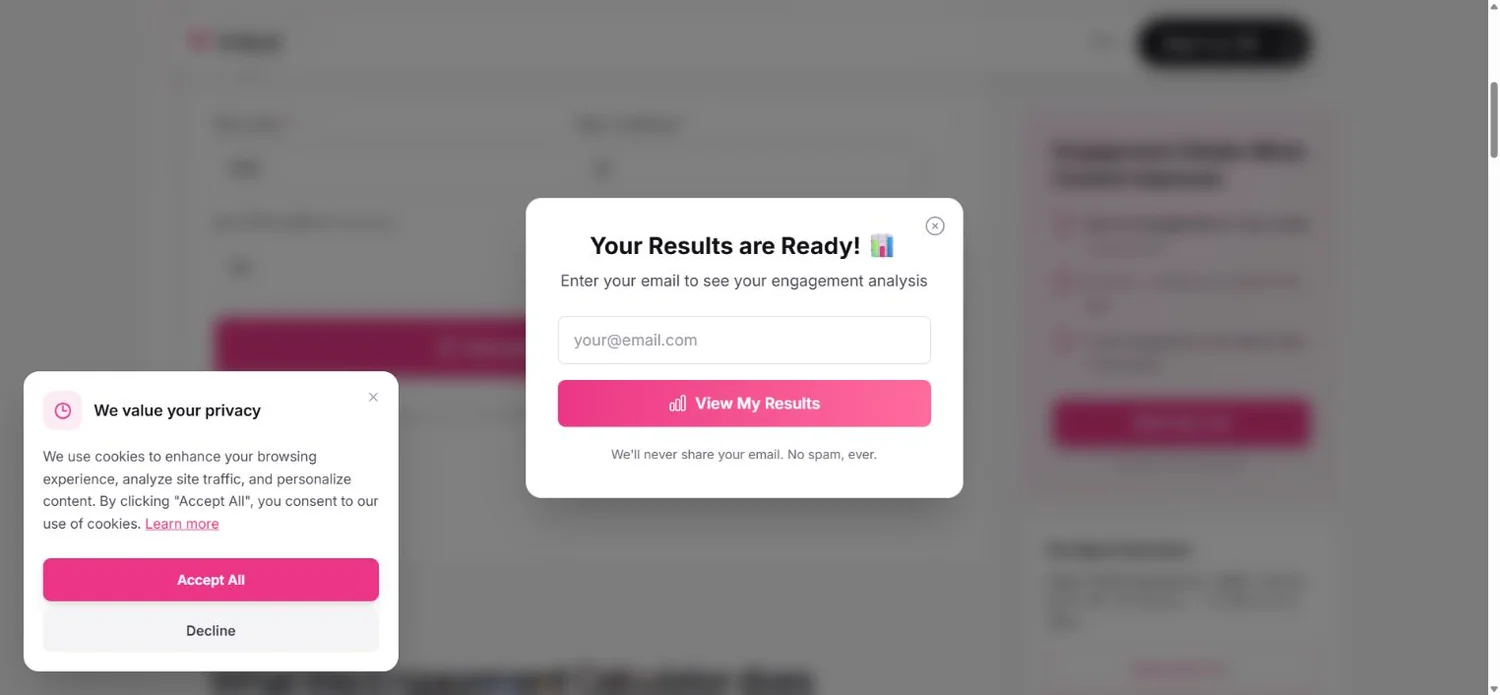
The first limit is the one we hit twice. Both public tools, the hook generator and the engagement calculator, asked for an email before showing their result. The FAQ, on another page, describes generation without an account and an email only for a bulk download. We did not provide an email, so we never saw the ten hooks, and we never saw the engagement rate the calculator computed. The arithmetic for the figures we entered is 5.7%, but Virlo did not display it, so we cannot say the calculation is right.
The second is a printed total that does not reconcile. The annual tab shows Pro at $139 a month and $1,671.60 a year. 139 times twelve is 1,668. The gap is small and the monthly figure is rounded, but the yearly charge is the number that leaves the account, and it is the one to keep.
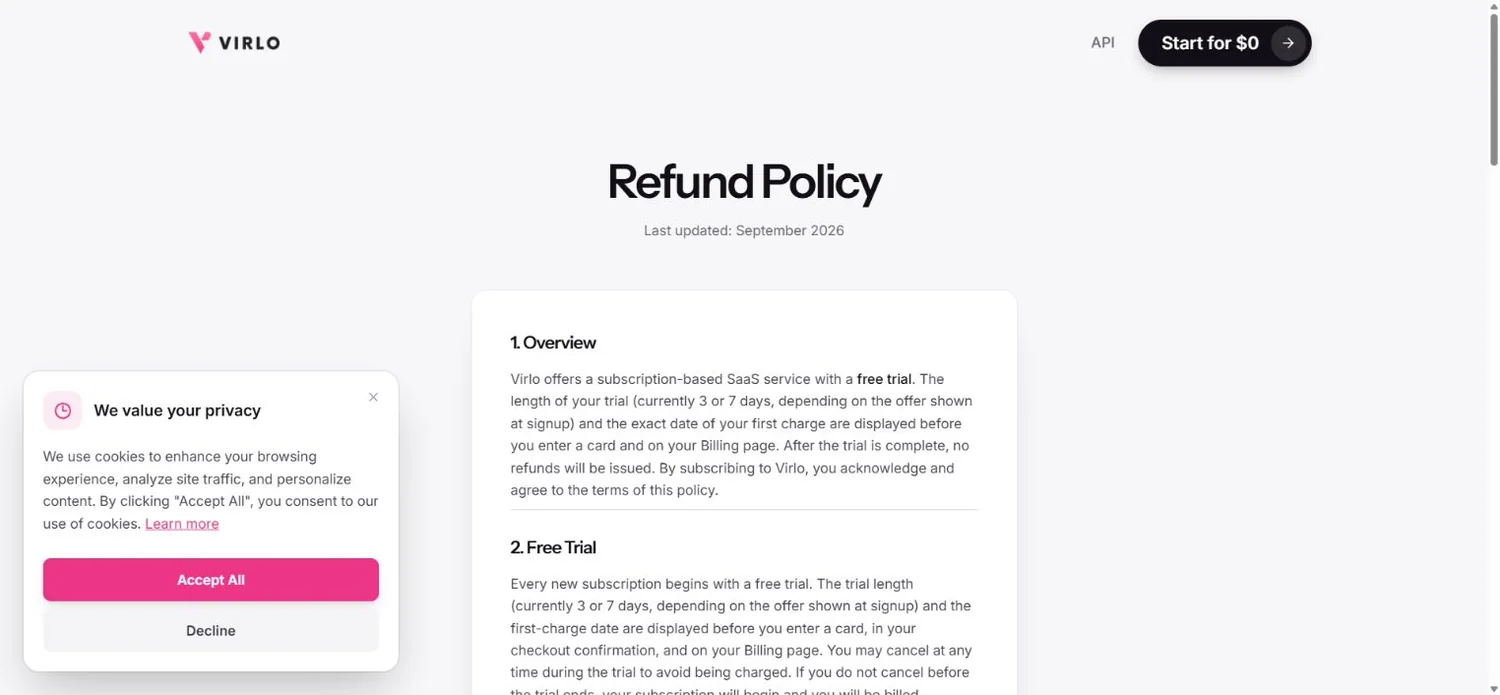
The third is the trial, which is not a single length. Seven days on the home page, three or seven depending on the offer in the refund policy.
The fourth is what happens after the trial: no refunds, annual subscriptions included, and no automatic return of credits when a run comes back empty because of the data limits.
And the fifth is the one that matters most and that we cannot answer: the data. Freshness, duplicates, coverage by country and the behaviour of the outlier score on a small niche are exactly what you are paying for, and no public page of this tool lets you check any of them.
Virlo alternatives
- Shortimize, from $99 a month, the closest equivalent, tracking creators and videos with its own credit logic.
- Foreplay, from $59 a month with one user and $20 per extra seat, an inspiration library aimed at advertisers rather than at pure research.
- TikTok Creative Center, free, the platform’s own trend and ad library, with no scoring by author and no script generation.
- Exolyt, analytics by account and by video, positioned on measurement rather than on ideation.
Virlo’s difference is the outlier score and the script that follows it. Its weakness is that the four others let you see something before you pay.
Who it is for
Agencies, UGC teams and brands that already publish short videos regularly and want a repeatable way to decide what to make next. The value is highest when you have a narrow niche and a real publishing cadence to feed, and lowest when you are looking for a one-off trend report, which the free platform tools already do.
It is not for someone who wants to publish: this is a research and preparation tool, and this audit found no evidence of publishing capability.
How we checked
We read the home page, the pricing page in both its monthly and annual views, the tools catalogue, the FAQ, the terms, the refund policy and the privacy policy on October 5, 2026.
The annual tab was genuinely clicked, which is where the $408 and $1,671.60 figures come from. The onboarding tab we were given pointed at a login rather than a dashboard, so we continued without an account, as the audit called for.
Two public tools were exercised with made-up data in English. The hook generator accepted a subject and a niche, ran through its steps and its percentage, then asked for an email before the ten hooks. The engagement calculator accepted 10,000 followers, 500 likes, 50 comments and 20 shares on TikTok and then asked for an email as well.
The demonstration player on the home page was opened. We looked at its screen and did not watch or transcribe the video, which is not a test of the agents.
What we did not test. No agent run, no script, no tracking, no export, no team permission and no API call. The data’s relevance, freshness and coverage are therefore unmeasured, and this review gives no verdict on them.
What to do next
Do not buy a year to discover the data. Take the shortest trial on the narrowest niche you actually work in, run one agent, and look at three things: whether the videos it returns are ones you had not seen, whether the scores match your own reading of the accounts, and whether the scripts it writes are usable as a brief without a rewrite.
Check the trial length on your own checkout screen rather than on the home page, since the policy allows both three and seven days. And keep the annual charge in mind as the printed yearly total, not as the monthly figure times twelve.
FAQ
Is Virlo free? There is no free plan for the application. The public tools are free to open, but in our visit they asked for an email before showing a result.
What does a hundred credits buy? One agent run. A creator tracked daily costs 15 credits a day and a video 10, so following one creator and one video for a month is 750 credits.
Do unused credits carry over? No, plan credits reset each cycle. The API balance is described separately as not expiring.
Does the trial give access to everything? We could not verify it: the trial length itself depends on the offer, and no plan was purchased here.
Is there a promo code? None was published on the pages we read. We publish a code only after trying it at checkout, and we tried none here.
Sources
Sources
- https://virlo.ai/ and https://virlo.ai/pricing, monthly and annual views, read October 5, 2026
- https://virlo.ai/refund-policy, September 2026, and https://virlo.ai/privacy-policy, August 1, 2026, read October 5, 2026
- the affiliate terms linked from the referral platform, read October 5, 2026
- https://shortimize.com/pricing and https://foreplay.co/pricing, read October 5, 2026, for the alternatives
Update log
- October 5, 2026: page published. Prices and totals read on the company’s own pages the same date, monthly and annual. Two public tools exercised, results blocked by an email request. No account, no payment, no API call.