What Context.dev does
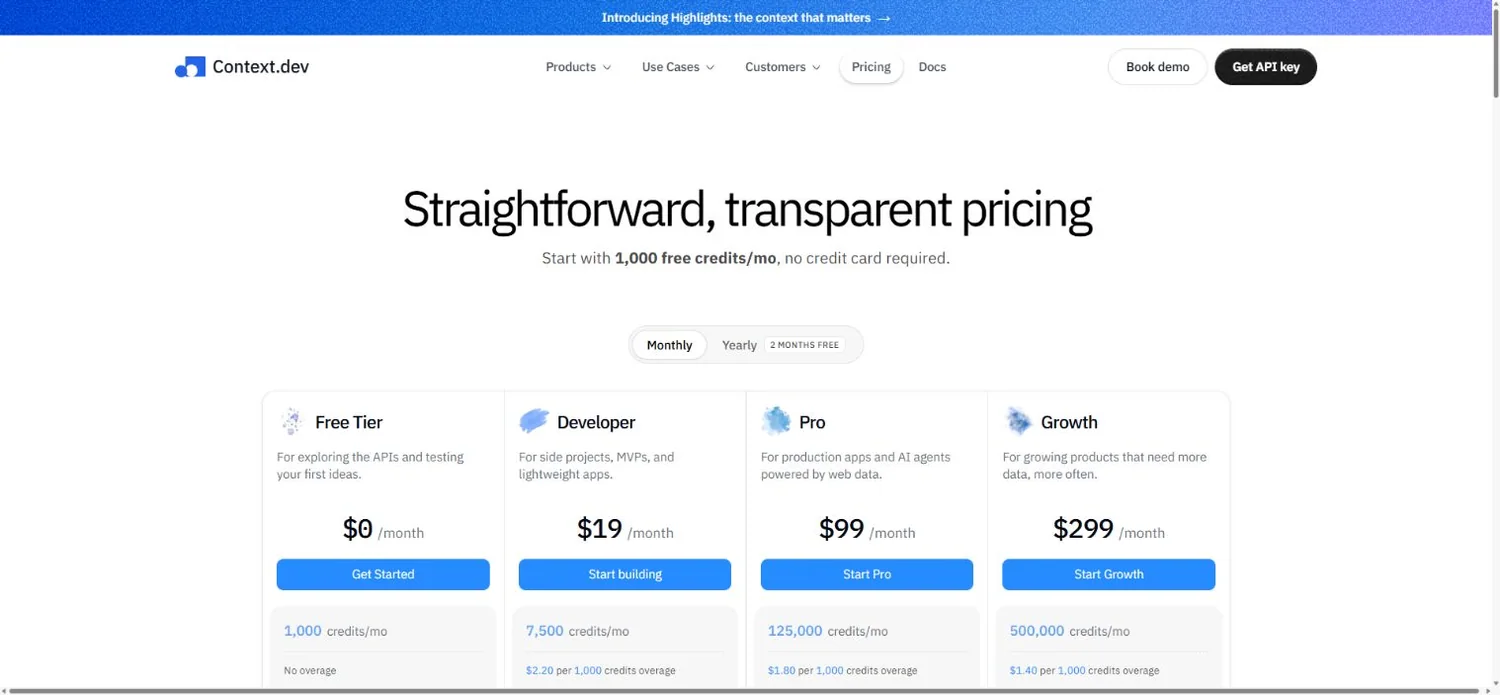
Context.dev turns web pages into data for something that is not a browser. Hand it an address and it returns markdown or HTML, a screenshot, a structured record built from a schema you describe, or an answer to a question with the pages it used. Around that core it also maps a domain to its URLs, crawls linked pages, parses documents, watches pages on a schedule and returns brand assets such as logos, colours and a slogan.
The pitch is aimed at agents and pipelines rather than at people. The site says web data infrastructure for AI agents, and the shape of the product matches: an API, SDKs for TypeScript, Python, Ruby, Go and PHP, a CLI, an MCP server, batches for asynchronous work and monitors with webhooks. The public demo shows the same functions through a form, which is how we tested them, and the playbook is deliberately narrow: a URL, a function, a few settings, and a result you can read as a preview or as JSON.
Two names float around the product and deserve care. Context.dev is not Context.ai, and the brand returns still point at media.brand.dev from the earlier name, which is what the site itself says. Nothing in the demo is a substitute for an integration: the same calls, made from code with a key, are the only way to judge the SDKs, the rate limits and the failure handling.
What you get for the money
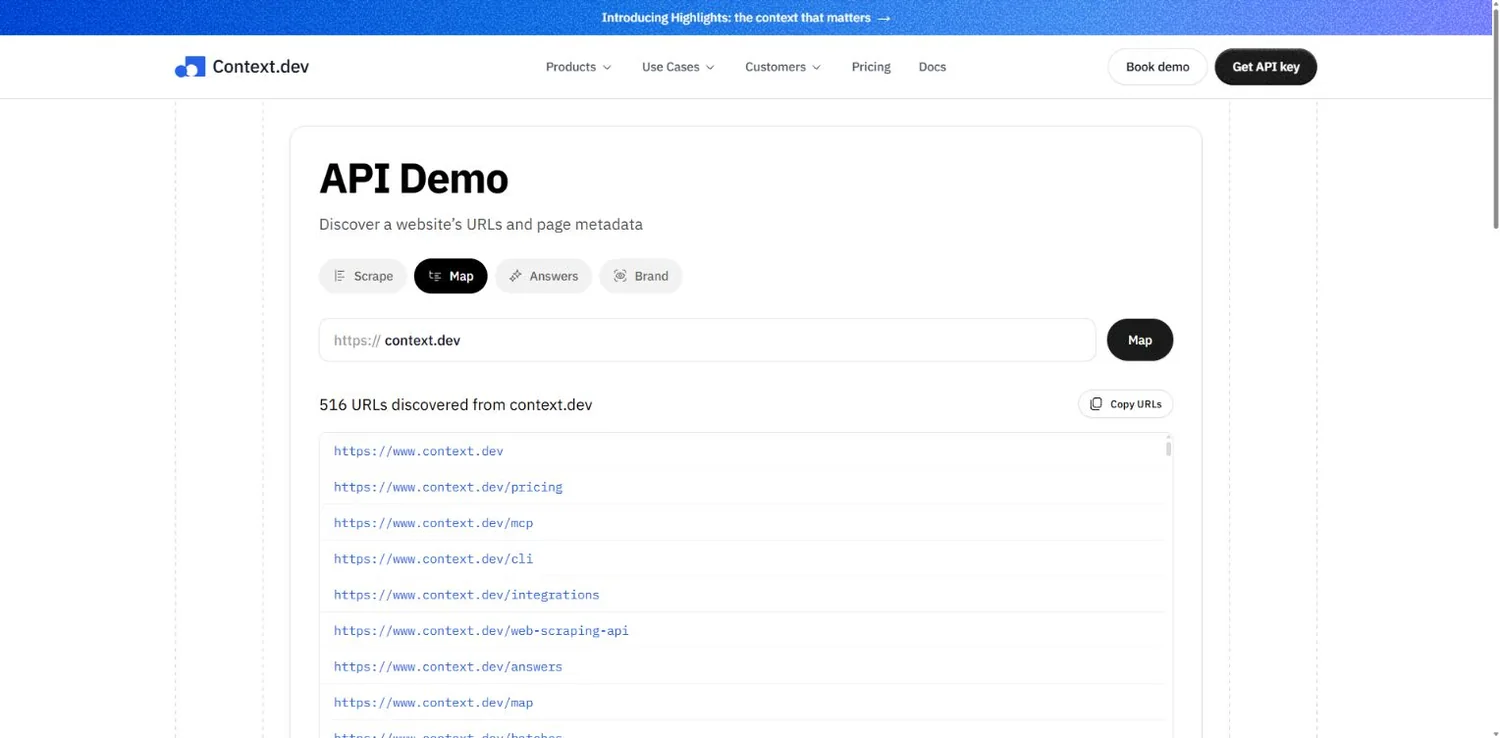
Everything on the account is paid from one credit balance, whichever function you call.
| Plan | Monthly | Credits per month | Overage per 1,000 credits |
|---|---|---|---|
| Free | $0 | 1,000 on a professional address | none |
| Free, personal address | $0 | 250 once | none |
| Developer | $19 | 7,500 | $2.20 |
| Pro | $99 | 125,000 | $1.80 |
| Growth | $299 | 500,000 | $1.40 |
| Scale | $499 | 1,000,000 | $1.00 |
| Enterprise | quoted | 2,000,000 and above | custom terms |
Paid yearly, the page advertises two months free, with monthly equivalents of $16, $83, $249 and $416. The free tier is the interesting one: 1,000 credits a month, enough for 1,000 standard scrapes, with no card, and the homepage adds 10,000 Logo Link requests once. Read the condition before counting on it, because the signup and the billing documentation both tie the monthly allowance to a professional email address, and a personal address is given 250 credits once instead.
What a credit buys is where the planning happens. A standard scrape costs 1, and 2 with JavaScript rendering or browser actions. Parse costs 1 plus 1 per page recovered by OCR. Answers costs 10 in Fast mode and 100 in Ultra, which the documentation calls the API default. Brand and Styleguide cost 10 each, batches 1 per successful URL, monitors 1 per page or sitemap run and 10 per extract run. JSON extraction adds 4 to a scrape, so a structured record costs 5. Failed and skipped runs are free, and so are prefetch, batch and monitor management, logs, webhooks and agent feedback. Cache hits, on the other hand, are billed.
Put together, 1,000 credits are 1,000 standard scrapes, or 200 structured extractions, or 100 answers in Fast mode, or 10 in Ultra, and those volumes share one balance rather than adding up. Unused credits do not carry over between months outside a plan change or a pause, automatic top-ups of 1,000 credits are described as enabled by default at checkout, and budget alerts notify rather than block. With no balance, the API is documented as answering 401 USAGE_EXCEEDED.
On this page
Where it falls short
- The bill moves with the function, not the request. A pipeline built on JSON extraction or Ultra answers consumes five to a hundred times what a scrape consumes, and the same 1,000 free credits disappear after 200 records or 10 questions.
- Cache hits are charged like fresh work. Two of the five results we looked at were served from a cache, one about two and a half hours old and one about forty-two hours old, and the documentation places cache hits in the normal billing.
- Free failures have edges. Failed and skipped runs are free, but a partially successful response can be billed, and handled 404s can be too.
- The free tier’s condition is not in the headline. One thousand credits a month applies to a professional address; a personal one gets 250 once, which changes the free tier from a habit into a test.
- Zero Data Retention is not a switch. It requires approval from support for the organisation and then a parameter on every call, and the documentation excludes Batches, Monitors and Brand retrieval from it. The privacy policy also allows queries and results to be used to improve and train the service’s models, subject to agreed terms.
- The percentages in the marketing are not measurements. The 99.96% scraping success rate and the 99.9% enterprise SLA are not the same metric and neither was measured here. The SOC 2 Type II badges are the company’s own declaration; no audit report was examined.
- Two affiliate durations on one page. The banner says 25% per sale for three years, the earnings section on the same page says one year. Anyone building revenue on that number should get it in writing first.
Context.dev alternatives
- Firecrawl, $19 a month (Hobby): 5,000 credits, $16 a month billed yearly, and $83 a month for 100,000 credits on Standard. The closest comparison on both function and price, with its own markdown and structured extraction.
- ScrapingBee, $19 a month (Hobby): 75,000 credits, far more volume per dollar at the entry price, aimed at scraping rather than at answers and brand data.
- Apify, $19 a month (Starter): $19 of usage included and pay-as-you-go above it, with a free plan carrying $5 of usage. Stronger on ready-made actors and scheduling than on a single extraction API.
- Exa, free to start: $10 of credits a month, then usage, at $0.005 a search call and from $0.012 for an agent run. A search index rather than a page fetcher, which matters if your need is discovery rather than extraction.
Who it is for: Context.dev
Context.dev fits a developer or a small product team that needs pages as data inside something else: a retrieval pipeline, an onboarding flow that dresses itself in a customer’s colours, a monitoring job, or an agent that has to answer from sources it can name. At $19 for 7,500 credits, the Developer plan is a reasonable first production step, and the published credit table means you can size it before you commit.
It is a poor fit if your whole need is occasional scraping, because the interesting functions cost multiples of a credit and the free tier is capped, once, on a personal address. It is also a poor fit for anyone who needs the strongest contractual position: the data retention question, the training permission and the compliance badges all rest on the company’s documents rather than on a report you can read.
How we checked
Unlike the research reviews on this site, this page reports operations we ran inside the public demo. No account was created, no key was used, no card and no payment details were given, and every field we typed was in English and fictional. Five operations, each with its own limit.
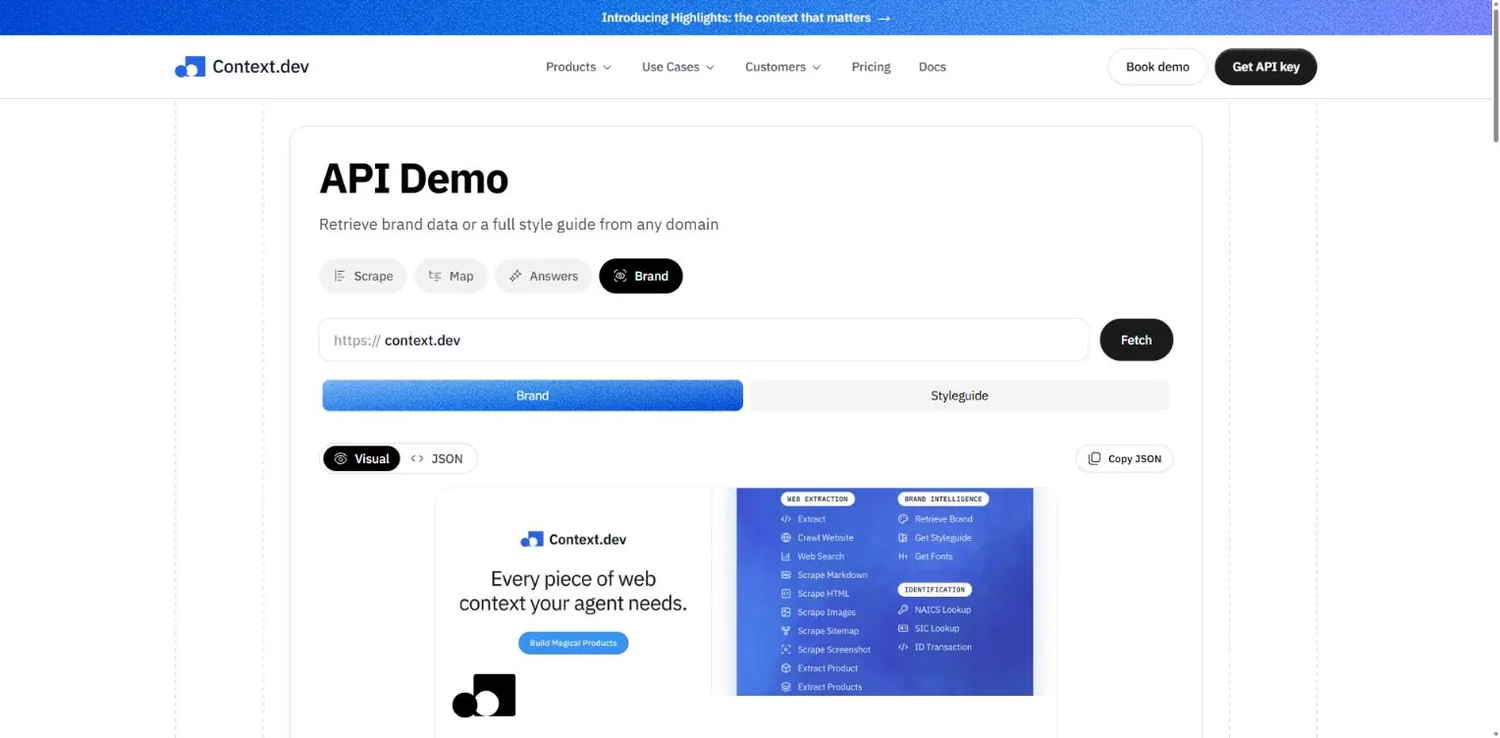
Scrape, on example.com, with markdown only: the page came back as text with its links, and the content matched the page as we opened it independently in a browser. The JSON said the markdown step succeeded and that the result came from a cache about two and a half hours old, so this was a successful extraction of a cached copy rather than a fresh fetch. Map, on context.dev itself in sitemap mode: the demo returned 516 URLs, including the homepage, pricing, integrations, documentation and articles. That is what the product returned for that domain at that moment; the pages discovered were not opened and 516 is not a measure of how much content exists. Answers, in Fast mode, on one factual question about the IANA example domains: the answer was short and the official IANA page appeared in the sources list, which we opened to confirm. Other domains were listed alongside it, so one official source was verified, not an exclusive diet of them. Brand, on context.dev: the demo returned a description, a slogan, colours, logos and social links that matched the site, and the JSON said that result was about forty-two hours old. The employee count and the email address returned in that response were not checked against any independent source. Scrape again, on the IANA help page, with HTML, markdown and a viewport screenshot together: all three steps reported success, the cache said miss with no age, the markdown kept the title, the paragraphs and absolute links while dropping the navigation and the footer, and the screenshot showed the page with its visual environment. That filtering is not the same thing as reframing an image.
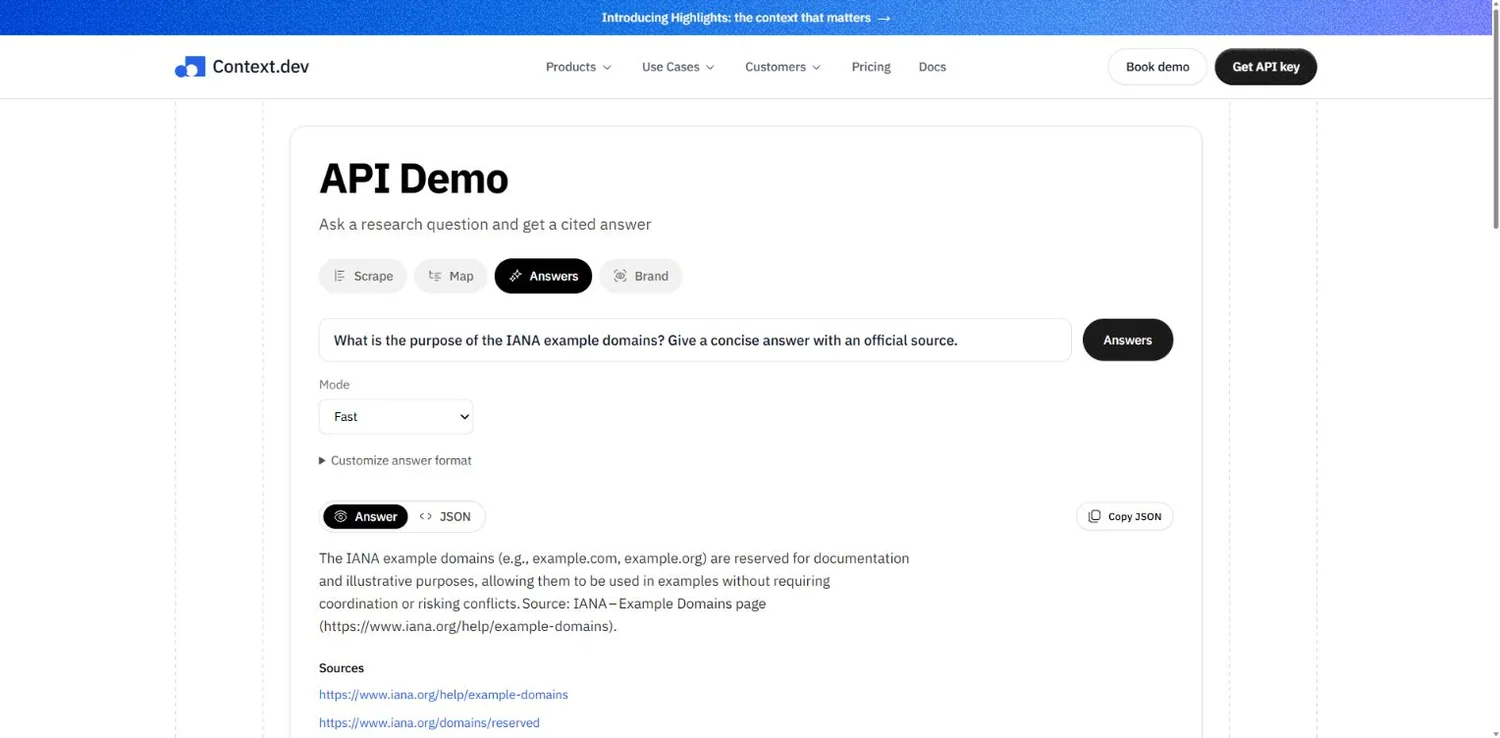
The metadata of the demo screens showed zero credits consumed and zero credits remaining, which is a property of the demo and not evidence that those calls are free in a real account. The browser’s own delays are not a latency measurement. Finally, we read the pricing page, the credits documentation, the terms of October 1, 2026, the privacy policy and the affiliate page on October 4, 2026. What we did not do: create an account, call the API with a key, run an SDK, submit a batch, create a monitor, send a document for parsing, use the people search, or buy anything.
What to do next
If you are building a pipeline, start on the free tier with a work address and spend the 1,000 credits on the shape of the calls rather than the volume: one JSON extraction, one answer in Fast and one in Ultra will tell you more about your real cost than a thousand scrapes. Work out your credit mix before comparing plans, since a record costs five and an Ultra answer a hundred, and check whether your workload can live with cached results, because they are billed. If your volume is scraping rather than answers and brand data, compare ScrapingBee at $19 for 75,000 credits and Firecrawl at $19 for 5,000 first, because the same money buys very different amounts depending on what you are actually calling. The Build and data hub groups the rest of what we have priced in this market.
FAQ
How much does Context.dev cost? The free tier is $0 with 1,000 credits a month on a professional address. Developer is $19 for 7,500 credits, Pro $99 for 125,000, Growth $299 for 500,000 and Scale $499 for 1,000,000. Overage runs from $2.20 per 1,000 credits on Developer to $1.00 on Scale. Prices are in USD, excluding taxes.
Is the free tier permanent? The pricing page says 1,000 credits per month with no card. The signup and the billing documentation tie that to a professional email address; a personal address gets 250 credits once.
Does every call cost one credit? No. Scrape starts at 1 credit, 2 with browser rendering. JSON extraction adds 4, answers cost 10 in Fast and 100 in Ultra, brand and styleguide 10. Failed and skipped runs are free.
Are cached results free? No. Cache hits are normally billed, and two of the five results we examined had come from a cache.
Can I test it without paying? Yes. The public demo ran five operations for us with no account and no card at all. That does not tell you what an API key would cost or what the SDKs are like to work with.
Is the commission 25% for three years? The rate is 25%, the duration is not settled: the same affiliate page says three years in its banner and one year in its earnings section. Treat three years as unconfirmed.
Sources
Sources
- context.dev/pricing (checked October 4, 2026), the plans, the credits, the concurrency and monitor allowances and the overage rates
- context.dev (checked October 4, 2026), the positioning, the free tier as stated in the FAQ, and the marketing percentages
- docs.context.dev/account/credits (checked October 4, 2026), what each call costs, the modifiers, the free runs and the billing behaviour
- context.dev/term (checked October 4, 2026), the company, auto-renewal, cancellation and refunds
- context.dev/privacy (checked October 4, 2026), the servers, the data collected, the training permission and the retention rules
- partners.dub.co/context-dev (checked October 4, 2026), the 25% rate and the two durations given for it
Update log
Published October 4, 2026 as a hands-on review, after five operations in the public demo with no account, no key and no payment. Prices, credits and conditions read from the editor’s pages the same day.