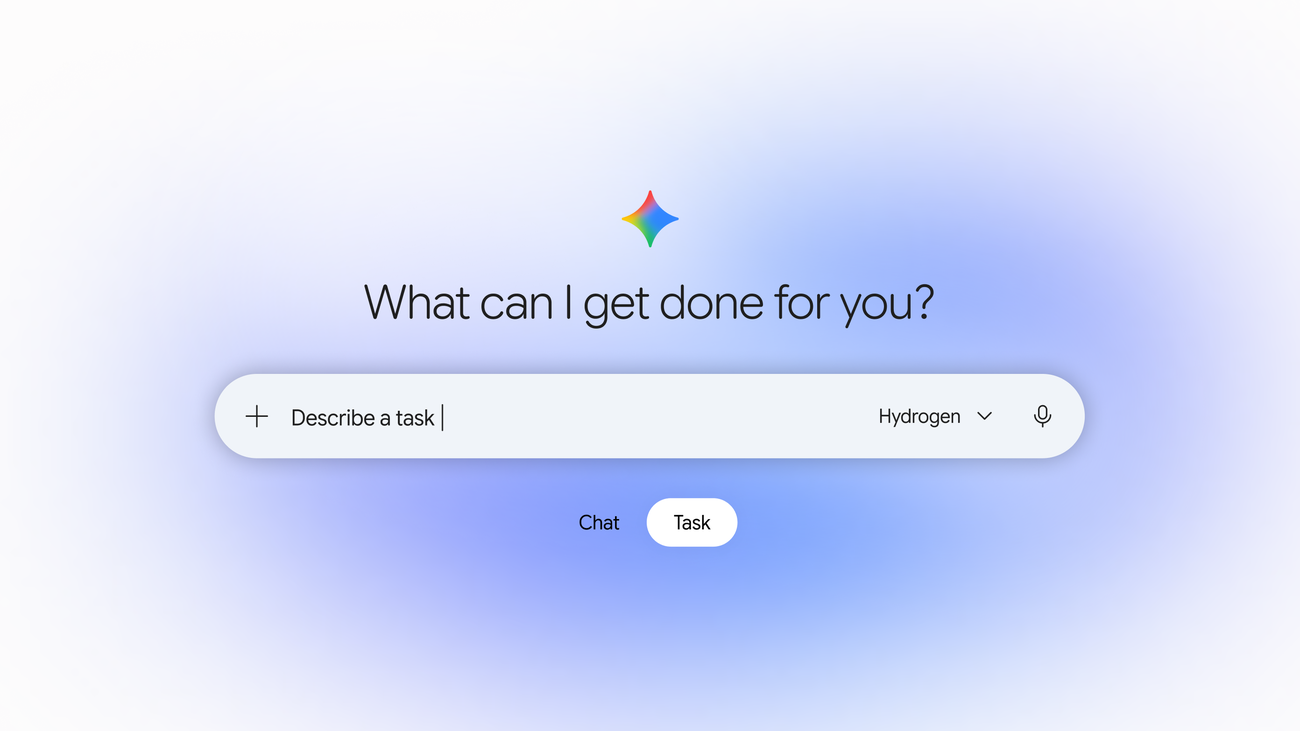
Google turned the Gemini app from an assistant that answers into one that acts on November 17, 2026, free in the United States, Japan, Korea, Canada, Australia and India. Signed by Josh Woodward, vice president of Labs, Gemini app and AI Studio, the post describes calls to businesses, appointments booked, bills analyzed and groceries bought with a card. The model behind it is Gemini 4 Hydrogen, named once and priced nowhere.
What was actually released
A mode, not a new app. The home screen toggle moves from Chat to Task, and the same job can start from a text message on Android and iOS after Settings, Channels, Set up under Text with Gemini. In the U.S., an email forwarded to gemini@google.com opens a task too. Google describes the rollout as free of charge for hundreds of millions of people in those six markets, with a second set of advanced features starting in the U.S.
The purchase path carries a paper trail. Gemini pays through the Agent Payments Protocol, with American Express coming soon and Mastercard and Visa as partners, and card details travel as digital tokens. Google says points, cashback and purchase protections still apply at checkout, and a hard spending cap can be set before the run. Receipts land in Google Wallet, which reaches iOS the same day.
The calling path has rules attached. Gemini tells the business it is an AI, businesses can opt out, and the assistant is designed not to hand over payment or private details without an explicit instruction. The demo is the author’s own minivan, a 2019 Honda Odyssey with a check engine light: two dealerships called at once, one appointment booked in under five minutes. A $389 electric bill and a grocery order come next, and Google says task mode reaches more than 60 apps.
Security: every task runs in a hardware isolated virtual machine on Google’s Agent Compute Engine, dedicated to one account, inside a sandbox its red teams test, with prompt injection filters and Safe Browsing limiting what it reads.
What the release actually changes
- The free tier of a major assistant now performs actions, not only text.
- Purchases run through an open protocol with tokenized cards and a cap set in advance.
- The model named for this work, Gemini 4 Hydrogen, has no published rate.
| Question | What Google states |
|---|---|
| Markets for the free rollout | U.S., Japan, Korea, Canada, Australia, India |
| Model | Gemini 4 Hydrogen, named once |
| Price of this rollout | Free, described as hundreds of millions of people |
| Payment | Agent Payments Protocol, Amex coming soon, Mastercard, Visa |
| Spending cap | Yes, set before the run, no default published |
| Connected apps | More than 60, no list |
| Task quota and failure rate | Not published |
What the claim rests on
The evidence is a product executive describing his own week. That proves the feature exists and Google will put its name to the purchase and calling behavior. It does not prove reliability. Nothing here gives a number of tasks attempted, a rate of wrong bookings, a latency figure or a cost per run. The “less than five minutes” is one appointment in one household, reported by the person shipping the product.
“Hundreds of millions of people” is a category of users, not a count, and no country by country figure is attached. The advanced features start in the U.S. with no list of what is inside that set, so a reader in Japan or Canada cannot tell whether calls, purchases and bill analysis all reach them.
The $389 bill is the most quoted number and the least checkable: one household, one utility, one month, with no earlier bill to compare and no way to know whether a person reading the same PDFs would have spotted the heat pump.
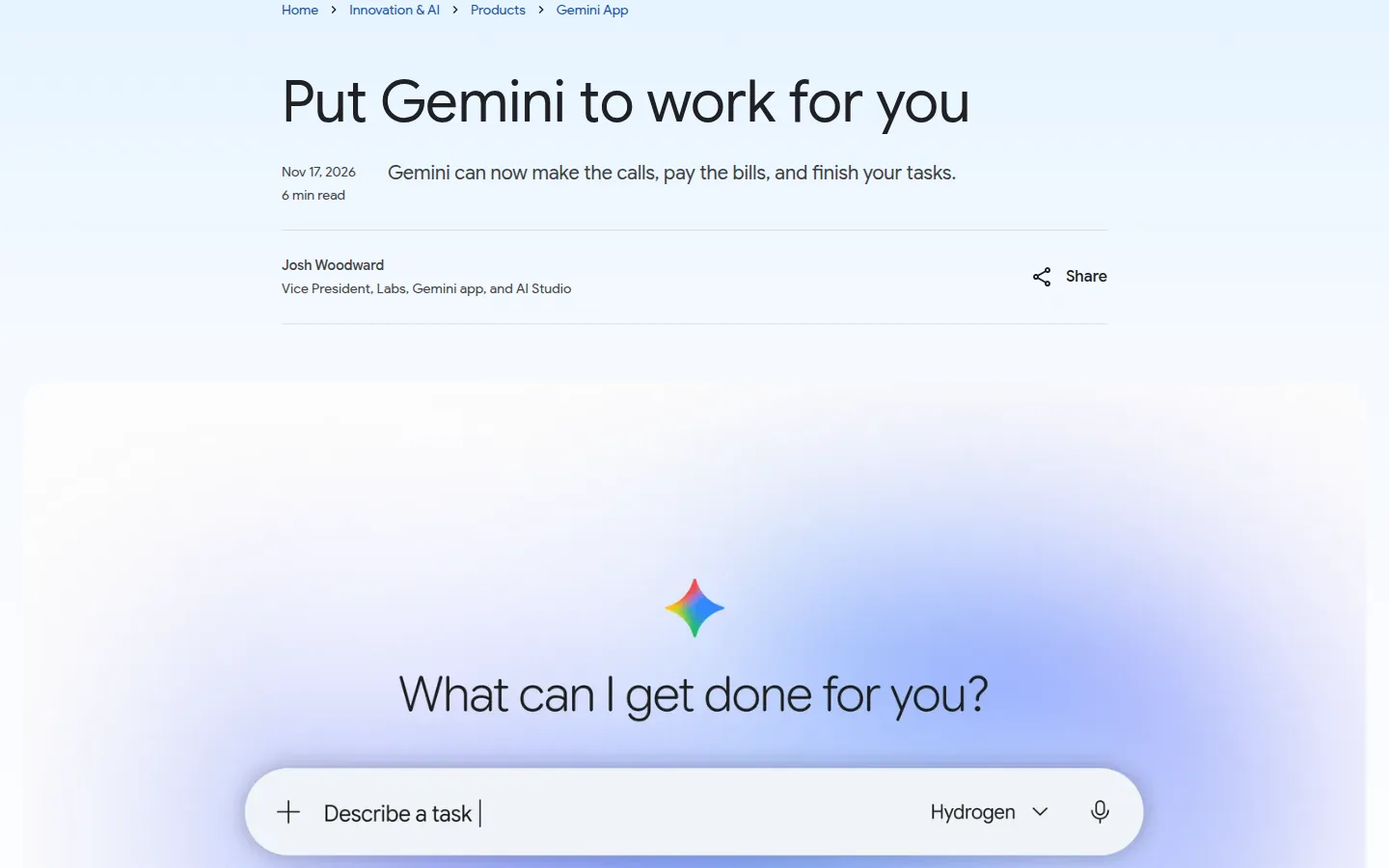
Gemini can now make the calls, pay the bills, and finish your tasks.
What is not published
No task quota, and no word on whether a run draws on the five hour meter that governs the chat plans or on one of its own. No default for the spending cap. No list of the 60 apps, no breakdown of the advanced set, no date outside the U.S., and no answer on who pays when a task books the wrong slot.
On this page
What it changes for someone choosing an assistant
Until this week the paid pitch of every assistant was action: the free tier answered, the paid tier did things. Google has moved the action layer into the free tier in six markets, so the monthly fee now buys context and quota rather than the ability to act. The comparison with ChatGPT and Claude turns on the meter and on the scope of the actions.
Our own grid, read on the subscriptions page on November 15, 2026, still holds as the price of the plans. It cannot answer what a task costs inside them.
| Plan | Monthly | Context window | Quota multiplier |
|---|---|---|---|
| Free | $0 | 32,000 tokens | 1x |
| Google AI Plus | $4.99 | 128,000 tokens | 2x |
| Google AI Pro | $19.99 | 1 million tokens | 4x |
| Google AI Ultra | $99.99 or $199.99 | 1 million tokens | 5x or 20x |
The meter refreshes every five hours against a weekly cap, and Google publishes no message count for any plan. A task that books a table is probably not billed like a chat message, and Google does not say which meter it lands on. A reader on Pro at $19.99 could find that a feature announced as free behaves like a paid one under load, or the opposite.
Outside those six markets, little changes: the United Kingdom, the European Union and Brazil are absent from the list, and no country calendar is attached. If your reason to subscribe was delegation rather than chat, the case for paying is unchanged this week.
The Neural Minute take
We have covered three Gemini 4 models in five weeks. Argon arrived on October 13, 2026 at an introductory $2 per million input and $10 per million output tokens, with no end date for that rate. Carbon followed on October 28 at the same rate, with a footnote naming $4 and $20. Hydrogen is named here as the model behind task mode, at no published rate.
That gap matters more here than in a model launch, because what is sold is a completed task. Two questions decide whether task mode belongs in your week: what a run costs against a plan you already pay for, and what happens when the run goes wrong. A wrong appointment wastes an hour. A wrong purchase moves money. The spending cap is the only control Google names, and the only one it leaves without a default.
A practical sequence, from the way we test tools: start on the free plan with one task whose failure is cheap, a restaurant booking or a service appointment, and watch the calendar and the meter. Set the cap explicitly before any purchase instead of trusting a default, and keep the Wallet receipts as the record. Better still, do not give task mode a card for work an email can do, because the risk change here is not the model but the payment credential.
The direction is clear: Google is betting an assistant wins on errands rather than on eloquence. The terms are not published yet, and this post reads as if a demonstration settles what the specification has not.
Sources
- Put Gemini to work for you, Google, dated November 17, 2026, read on November 17, 2026.
- Josh Woodward, author page on the same site.
- Our review of Google Gemini, plan prices read on the subscription page on November 15, 2026.