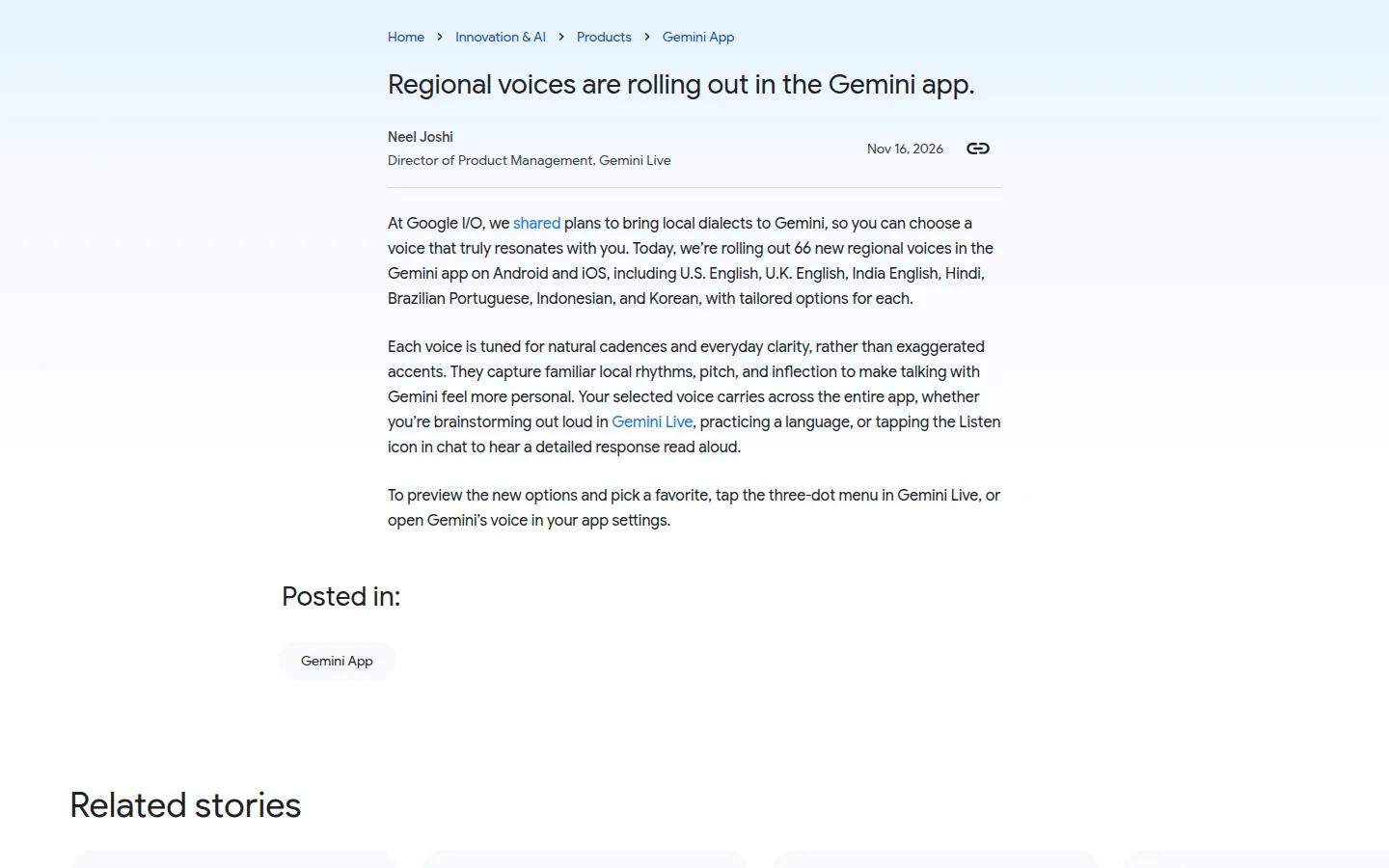
Google began rolling out 66 new regional voices in the Gemini app on Android and iOS on November 16, 2026. The post is signed by Neel Joshi, director of product management on Gemini Live, and names seven families among the 66: U.S. English, U.K. English, India English, Hindi, Brazilian Portuguese, Indonesian and Korean, each with tailored options inside it. It is a voice release, not a model.
What was actually released
The release is a set of voices. Nothing in the app’s list of abilities moves with it: the post describes how the assistant sounds, how many choices the picker holds, and where the choice is made. Google ships 66 voices inside seven named language groups, on Android and iOS, with the count per group left open.
The technical claim sits in one sentence. Google says each voice is tuned for natural cadences and everyday clarity, and that the accents are deliberately not exaggerated. That is a design target set against the caricature voice assistants have carried for years: local rhythm, pitch and inflection, a voice meant to sound like the person using it rather than like a performer reading a script.
The picker is account-wide, and this is the part that changes daily use. A voice picked once follows the account into Gemini Live, into language practice and into read-aloud. The last of the three is the quiet one: the Listen icon reads a long answer out loud in the voice picked in settings, on every device on the account.
| Question | What Google states |
|---|---|
| Voices | 66 new regional voices |
| Platforms | Gemini app on Android and iOS |
| Languages named | U.S. English, U.K. English, India English, Hindi, Brazilian Portuguese, Indonesian, Korean |
| Count per language | Not published |
| Countries and markets | Not published, no list |
| Plan or price | Not published, no tier named |
| Timing | Rolling out, no finish date |
| Where to pick a voice | Three-dot menu in Gemini Live, or voice in app settings |
What to remember
- The number is 66 voices across seven named language groups, not 66 languages.
- No tier, no price and no date is attached to the release.
- The picker sits in Gemini Live and in the app settings.
What the claim rests on
Each voice is tuned for natural cadences and everyday clarity, rather than exaggerated accents.
That sentence and the number 66 are the whole evidence base. Google does not publish the list of the 66, the distribution inside each group, the countries served, or a date by which a given language arrives. A reader whose language sits outside the seven named families cannot tell from the post whether it is among the 66 at all.
The quality claim is a statement of intent. Natural cadences is a target, and the post carries no listening test, no preference data, no comparison against the voice set it replaces, and no error rate on the words a read-aloud voice gets wrong first: numbers, currency, dates, place names and surnames. A count of 66 measures coverage. It does not say whether the Korean voice reads a price correctly.
The post also ships without a sample: no audio clip, no video, no image of the picker. The one thing a reader needs in order to judge the claim, the sound itself, exists only inside the app.
The second silence is on the input side. These are voices the reader hears, and nothing in the post says Gemini recognizes a regional accent better than it did before. The two jobs run on different pipelines, recognizing speech and generating it, so a reader who wanted to be understood in a dialect rather than answered in one gets no answer here.
What is not published
No list of the 66 voices, no count per language, no country or market list, no finish date, no plan that gates the feature, and no word on whether speech recognition of the same accents moved. Nor whether one engine serves all seven families, which is the difference between a local voice and an English voice reading local text.
On this page
What it changes for Gemini users outside the US
For a reader outside the United States, the change is small and it is real. English now arrives in three rhythms, U.S., U.K. and India, and that matters most on the tokens that break a synthetic voice: numbers, currency, dates, place names and surnames. A long answer read aloud stops being a chore when the rhythm is the familiar one, and the Listen icon is where most people will meet these voices, not Gemini Live.
The named non-English families are the larger signal. Hindi, Brazilian Portuguese, Indonesian and Korean are on the list, which means the app speaks them in a local voice instead of an English voice reading foreign words. Google gives no quality figure per language, so the post cannot rank them, and the practical test is short: open Gemini Live, tap the three dots, listen, keep the one that survives a paragraph about a bank transfer.
For a reader whose language is not among the seven, the release reads as a first slice rather than a complete voice catalog.
The Neural Minute take
Our Google Gemini review read the plan grid on November 15, 2026 and recorded Gemini Live inside the free plan, with Google AI Plus at $4.99 a month and Pro at $19.99. None of those tiers is named in this post, so nothing in the release asks a reader to pay, and the main complaint in our review does not move: Google still publishes no message count, so the meter remains the part of the bill nobody can forecast.
What does move is the cost of leaving. Voice is the surface a subscriber lives with, the part running while driving, cooking or walking, and the hardest part of an assistant to compare on a spec sheet, because two voices cannot be judged without living with them for a week. Google is spending on the one layer where a rival cannot be dismissed with a benchmark table, which is spending on retention rather than on capability.
The honest reading of the number is coverage. Sixty-six voices inside seven families means most of the 66 are variants inside groups the post does not break out, which is good news for a reader in the U.K. or Brazil and no news for a reader in Poland or Vietnam. Google is shipping breadth of accent ahead of breadth of language, the cheaper order, and the one that fits a product already translated into a set of languages.
Two things we will watch. The first is whether the full list lands anywhere, because a count without a list is a marketing number, and voice options are the kind of feature where readers want to find their language by name. The second is the input side: if Google tunes recognition of the same accents next, this stops being cosmetic. Until then it is a better sounding assistant, not a better listening one.
Sources
- Regional voices are rolling out in the Gemini app, Google, by Neel Joshi, published November 16, 2026. The page read here for the count, the seven named language groups, the tuning claim, the picker paths and the Google I/O reference.
- Google Gemini review, Neural Minute, plan prices read on November 15, 2026. Used only to check what each tier includes.